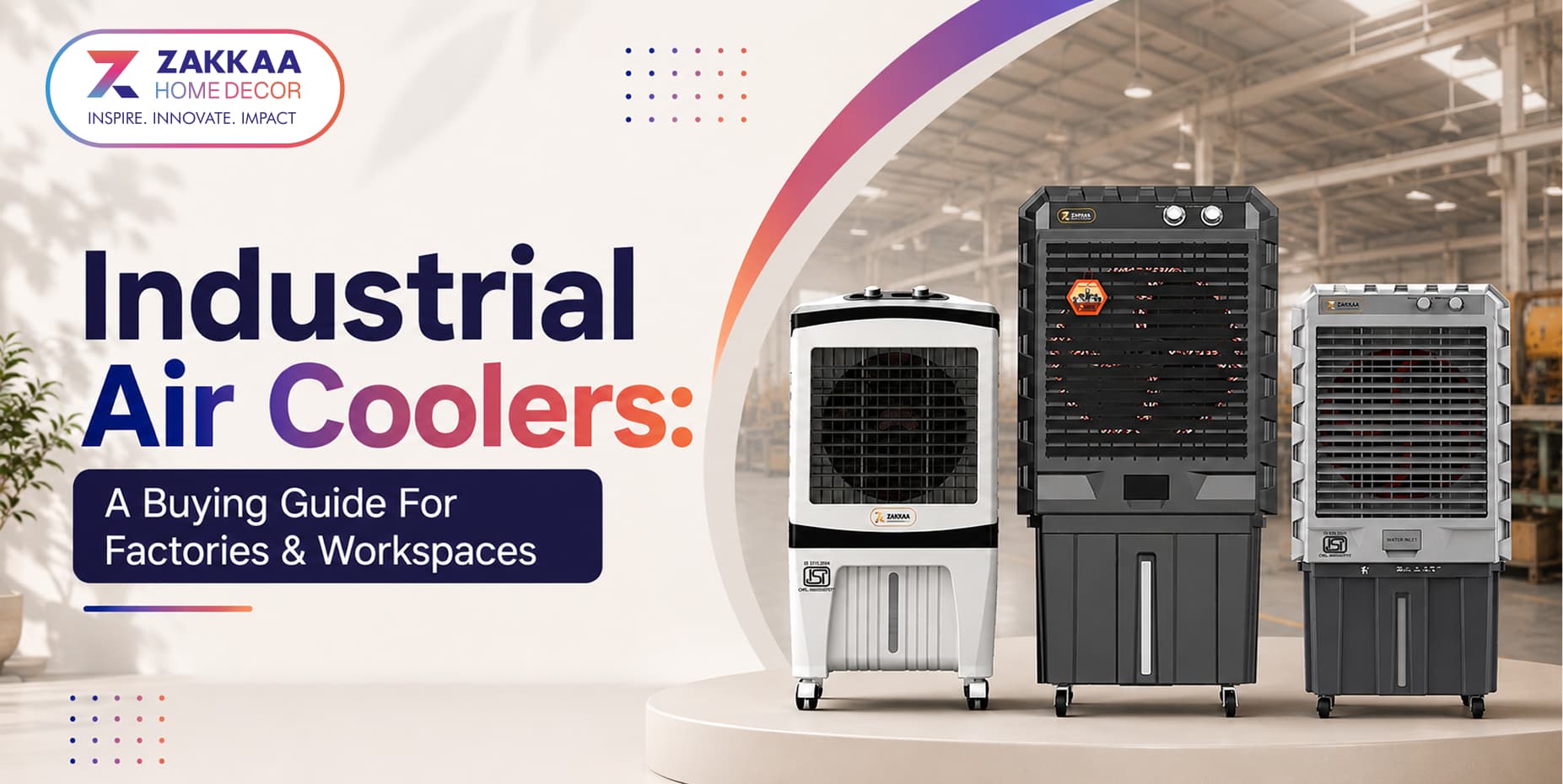
Aug 18, 202613 min readBy Aditya Singh
Ask anyone working inside a hot factory or warehouse what they notice first during summer, and the answer is unlikely to be the electricity bill. It is the heat they feel while standing near machinery.
Excessive heat can affect working conditions, employee comfort, equipment surroundings, and the day-to-day productivity of people spending long hours inside factories, warehouses, workshops, and other demanding workspaces.
Yet cooling a large industrial area is very different from cooling a conventional room. That is why choosing an industrial air cooler is not simply about buying the model with the biggest airflow number. An air cooler that works well in a small workshop may be completely unsuitable for a large factory, warehouse, loading bay, or semi-open production area.
A factory and a workshop also have very different cooling requirements from an office or residential room. Open doors, ventilation, ceiling height, heat-generating equipment, worker density, and humidity can all influence how well evaporative cooling performs.
So before you compare brands or prices of air coolers for industrial use, it helps to understand what the cooling environment actually demands. This guide takes you through the key considerations to buy an air cooler for your factory, from airflow and coverage to cooler design, power consumption, maintenance, and overall value.
What Are Industrial Air Coolers?
Industrial air coolers are high-capacity cooling appliances designed to provide airflow and evaporative cooling across large areas such as factories, warehouses, workshops, manufacturing plants, garages, and commercial workspaces. They are generally built for higher airflow, longer operating hours, and demanding working environments compared with residential air coolers.
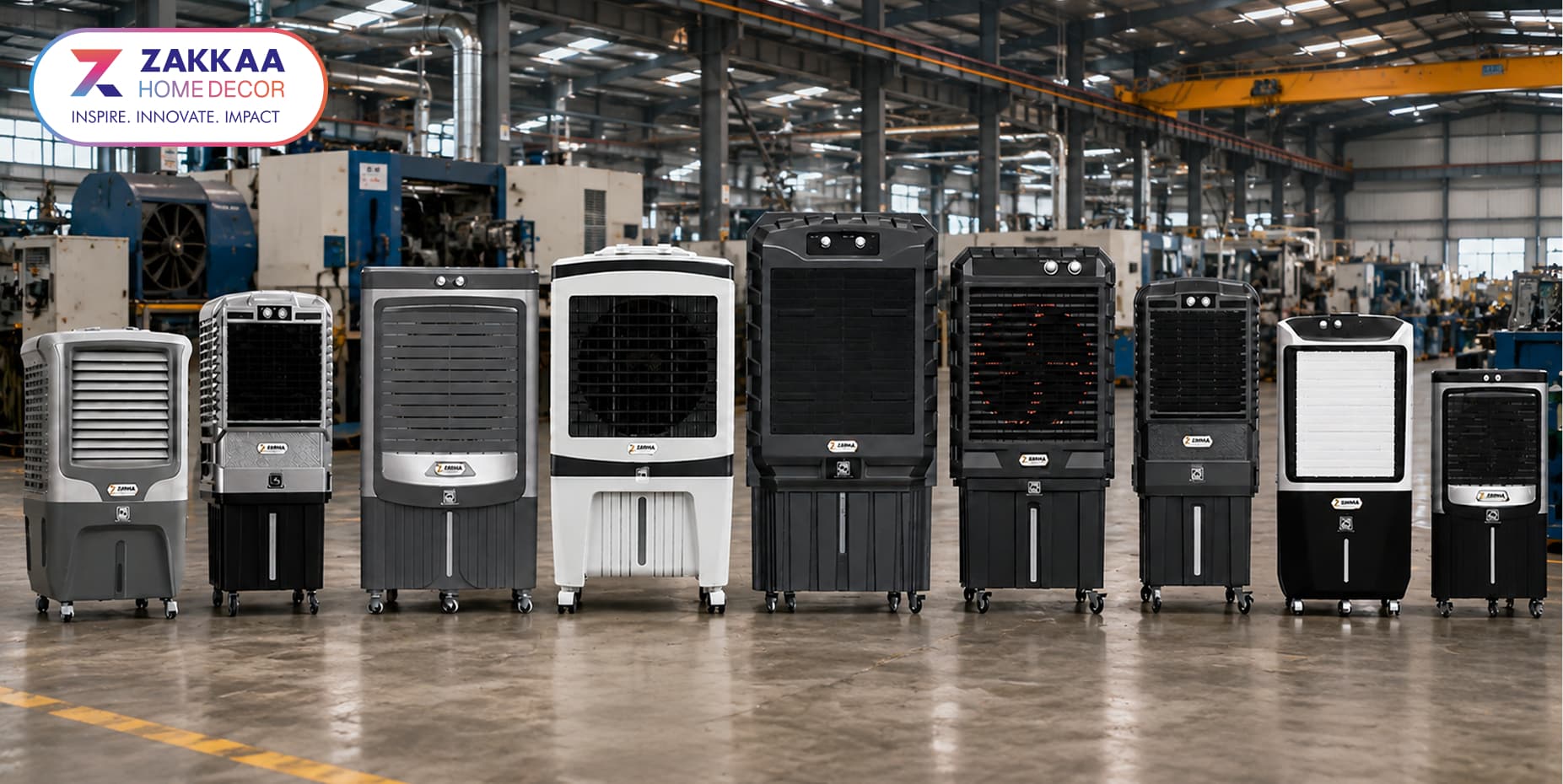
An industrial evaporative air cooler draws warm air through wet cooling pads, where water evaporation lowers the temperature of the passing air. The cooled air is then circulated into the workspace using a powerful fan.
Because the system relies on water evaporation rather than compressor-based refrigeration, industrial coolers can be useful for businesses looking for practical factory cooling solutions, particularly in hot and dry parts of India.
How To Select And Buy A Heavy-Duty Industrial Air Cooler?
Buying a heavy-duty industrial air cooler should start with the working conditions of your facility, not just the cooler's tank size or advertised airflow. A factory with heat-generating machinery, high ceilings, multiple shifts, and open production areas has very different cooling requirements from a small workshop. Before placing a bulk order for an industrial portable air cooler, assess the cooling area, heat load, airflow, operating hours, ventilation, water availability, maintenance needs, and electrical consumption.
1. Start With The Actual Cooling Area
Don't calculate your requirement only from the total factory floor area. Identify where workers actually need cooling and whether some sections generate considerably more heat than others.
For example, a 20,000 sq. ft. manufacturing plant may have storage space, offices, production lines, and loading areas. Cooling the entire facility in the same way may not be necessary. A production section with workers and machinery may require much stronger airflow than a storage section.
Also check:
Floor area
Ceiling height
Worker density
Machinery placement
Doors and shutters
Existing exhaust systems
Areas where heat builds up
Practical point: A high-roof factory can require a different cooling arrangement from a low-ceiling workshop even when both have the same floor area.
2. Check Airflow Before Water Tank Capacity
For industrial cooling, airflow is one of the most important specifications to compare. A large water tank only tells you how much water the cooler can hold; it does not tell you how effectively cooled air will reach the workers.
When comparing models, check the manufacturer's specifications for:
Airflow capacity
Air throw distance
Fan performance
Air outlet design
Swing function
Cooling-pad area
Recommended coverage
Number of units required
For a large production floor, several appropriately positioned coolers may provide better worker-level cooling than one very large unit placed at a single point.
3. Identify Heat-Generating Areas
Your cooling requirement should reflect the heat load inside the facility. Welding stations, furnaces, ovens, compressors, motors, generators, and heavy machinery can create significantly more heat than ordinary storage areas.
Map these heat sources before deciding where to install coolers. If employees work close to these machines, they may need direct or dedicated airflow rather than relying on a cooler located elsewhere on the floor.
For fabrication and engineering facilities, this assessment is particularly important because the cooling requirement can vary considerably between workstations.
4. Match The Cooler To Your Operating Hours
A cooler used for two or three hours a day has different requirements from one operating throughout an 8-, 10-, or 12-hour shift.
For long operating schedules, look beyond cooling output and check the components that will be used continuously. Pay attention to motor quality, water pump, cooling pads, tank construction, electrical components, water-level management, drainage arrangement, ease of cleaning, and availability of replacement parts.
For a business, downtime can be more expensive than a slightly higher purchase price. A model that is easier to inspect, clean, and service can therefore be more practical for continuous industrial use.
5. Check Ventilation Before Buying
Ventilation is not an optional consideration for evaporative cooling. An industrial evaporative air cooler introduces cooled air into the workspace, so there should be a suitable path for hot air to leave.
Open shutters, windows, roof ventilators, exhaust fans, and other openings can support air movement. In contrast, a completely sealed factory may not be an ideal application for evaporative cooling.
Before installation, look at the direction of existing airflow. The objective is to bring fresh air through the cooling pads and allow warmer air to escape rather than trapping it inside the building.
6. Check Water Availability And Maintenance
Industrial coolers can consume significant amounts of water during extended operation, so check whether your facility has a convenient water supply and drainage arrangement.
Also ask the manufacturer how the tank, pump, cooling pads, and water-distribution system should be maintained.
Easy drainage is particularly useful for factories because the tank can be emptied during cleaning instead of leaving stagnant water inside the cooler between operating periods.
7. Compare Electricity Consumption
One reason businesses consider an industrial air cooler is its potentially lower electricity consumption compared with compressor-based cooling. However, don't assume every cooler will have the same running cost.
Check the rated power consumption of the model and calculate it against your expected daily operating hours.
For example, if a cooler is rated at 500 W and operates for 10 hours, its theoretical electricity consumption is:
0.5 kW × 10 hours = 5 kWh per day
Actual consumption can vary depending on operating conditions and speed settings, but this calculation gives a business a useful starting point for estimating running costs.
8. Ask The Manufacturer For Application-Based Guidance
This is where an experienced industrial air cooler manufacturer can add real value. Instead of asking only,
“Which is your biggest cooler?”
Share your facility details and ask the manufacturer to recommend a suitable configuration. Provide information such as:
Factory or warehouse area
Ceiling height
Location and climate
Number of workers
Operating hours
Major heat sources
Ventilation openings
Preferred portable or fixed arrangement
Expected quantity
A manufacturer can then assess the application and help determine the appropriate model, number of units, and placement.
How To Calculate The Number of Evaporative Industrial Coolers Your Factory Needs
There is no single number that works for every factory because cooling depends on room volume, airflow, heat load, climate, ventilation, and the cooler's specifications.
A practical starting point is to calculate the area and compare it with the manufacturer's stated coverage or airflow capacity.
For example, suppose a production area is 10,000 sq. ft., and the selected cooler is suitable for approximately 2,500 sq. ft. under your operating conditions.
10,000 ÷ 2,500 = 4 coolers
So, you would start with approximately four units and then assess placement, machinery heat, worker density, and airflow requirements.
For a more accurate industrial installation, don't rely only on square footage. A manufacturer or HVAC professional should assess the site's heat load and ventilation before finalising the number and placement of units.
Tip: It is often better to distribute several suitably sized coolers across worker zones than to depend on one extremely powerful unit at one end of a large factory.
Different Types of Industrial Air Coolers Industrialists Can Buy
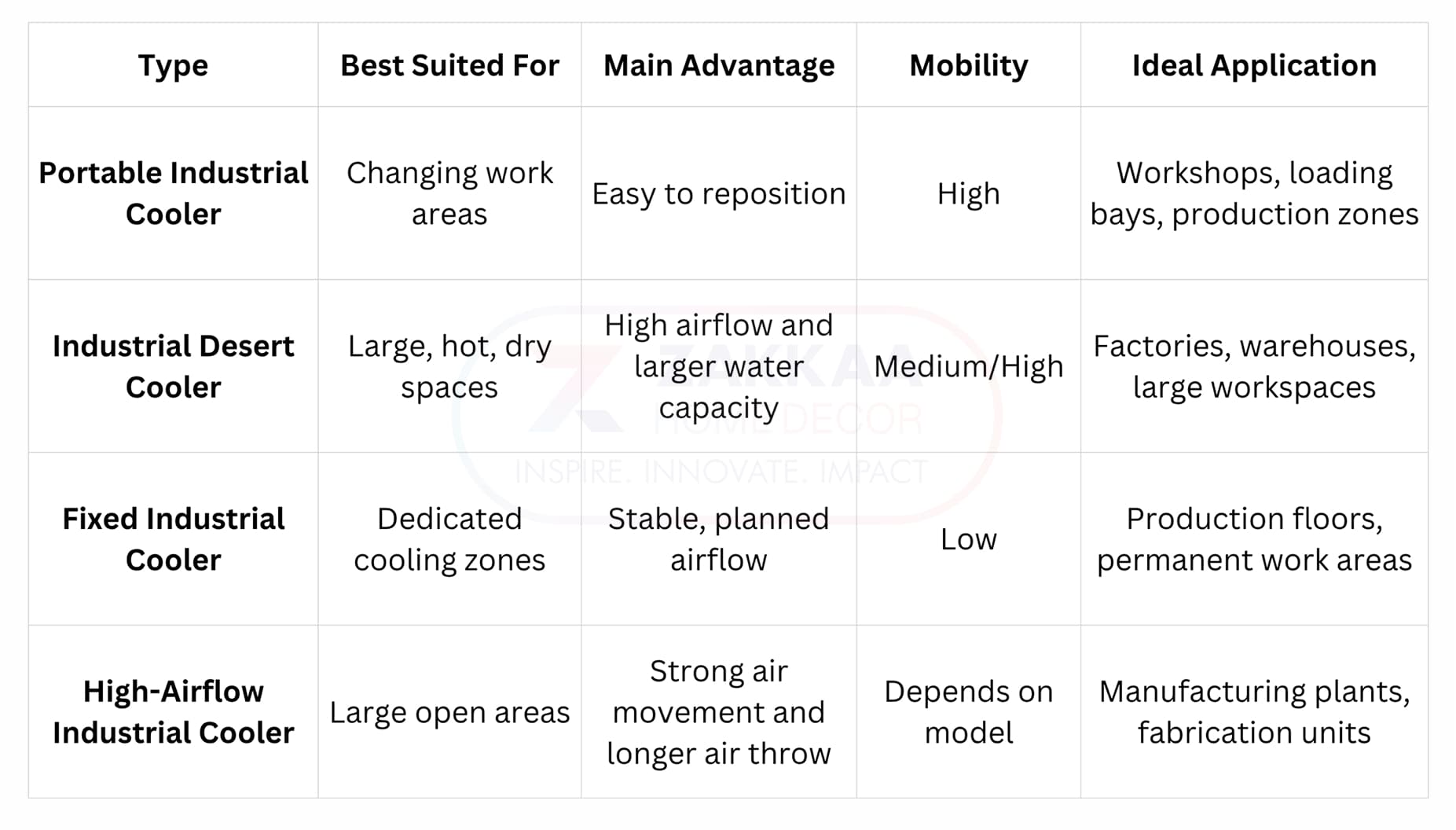
Industrial air coolers are not one-size-fits-all. Factories, warehouses, workshops, and semi-open workspaces may need different cooler designs depending on area, airflow requirement, mobility, and operating conditions. Before buying, understand what each type is designed to do rather than choosing only by capacity or price.

1. Portable Industrial Air Cooler
A portable industrial air cooler is designed for businesses where cooling requirements change between work areas. Heavy-duty wheels make it easier to move the unit between production sections, workshops, loading areas, or temporary workstations.
It works well when you don't want a permanent cooling installation or when only specific areas require additional cooling during different shifts.
2. Industrial Desert Air Cooler
An industrial desert air cooler is generally designed for large areas and hot, dry conditions. It typically combines a larger water tank with high airflow to circulate cooled air across spacious workplaces.
This type can be considered for manufacturing floors, warehouses, workshops, and other large ventilated areas where stronger air movement is required.
3. Fixed Industrial Air Cooler
A fixed industrial air cooler is positioned permanently at a selected location instead of being moved around the facility. It can be suitable when a particular production area consistently requires cooling.
Because the cooling position is planned in advance, fixed units can be incorporated into a broader factory cooling solution, particularly where multiple units are strategically placed across a large facility.
4. High-Airflow Industrial Air Cooler
These models focus on moving a large volume of air over a considerable distance. They can be useful in large production halls, fabrication units, and areas where workers are positioned farther away from the cooler.
For these applications, check the manufacturer's airflow and air-throw specifications rather than judging performance by motor size alone.
Comparison of Industrial Air Cooler Types
Important Features To Look For While Buying Air Cooler For Industrial Use
When comparing industrial cooling equipment, focus on features that support long operating hours and easier maintenance.

High Airflow: Strong airflow is essential for moving cooled air across large production areas and workspaces.
Large Water Tank: A larger tank can reduce frequent refilling during long shifts.
Durable Cooling Pads: Good-quality cooling pads support effective evaporation and need to withstand regular industrial use.
Powerful Motor: The motor should be suitable for the expected operating hours and airflow requirements.
Multiple Speed Settings: Speed control allows businesses to adjust airflow according to temperature and working conditions.
Auto Swing: Auto swing can distribute airflow across a wider area instead of directing it continuously towards one location.
Easy Drainage: An accessible drainage system makes it easier to empty and clean the water tank during routine maintenance.
Castor Wheels: For portable models, heavy-duty wheels can make repositioning easier across the factory or workspace.
Easy Maintenance: Industrial coolers should provide convenient access to cooling pads, water tanks, filters, and other components that require regular cleaning.
Where Can Industrial Air Coolers Be Used?
An air cooler for industrial use can be suitable for several workplaces where large areas need cooling and maintaining a fully enclosed, air-conditioned environment may not be practical. Common applications include:
Manufacturing plants
Factories
Warehouses
Workshops
Garages
Automobile service centres
Printing units
Fabrication facilities
Production floors
Loading and unloading areas
Large retail or commercial spaces
Semi-open work areas
Industrial coolers are particularly useful where doors remain open, fresh air circulation is required, or cooling needs to cover a large working area.
What To Check Before Buying From An Industrial Air Cooler Manufacturer
Choosing the right industrial air cooler manufacturer matters as much as choosing the cooler itself, particularly when purchasing multiple units.
Ask the manufacturer:
Can you manufacture according to our quantity requirements? Production capacity matters when you need dozens or hundreds of units.
What airflow and coverage can the model provide? Don't accept a coverage figure without understanding the conditions behind it.
Can the product be customised? This can matter when your business needs specific dimensions, colours, components, controls, or other requirements.
What quality checks are performed? Ask how the motor, pump, cooling pads, electrical components, body, and finished product are checked.
What after-sales support is available? Confirm warranty terms, replacement parts, service availability, and maintenance support.
Can you support repeat orders? A reliable OEM partner should be able to maintain agreed specifications when you reorder.
For businesses buying at scale, these questions are more useful than simply comparing catalogue prices.
Why Zakkaa For Industrial Cooling Solutions?
Zakkaa is India’s leading OEM manufacturer and industrial cooling solutions provider, offering air coolers for factories, warehouses, workshops, commercial spaces, and other large-area applications. With in-house manufacturing capabilities, Zakkaa can support businesses looking for industrial air coolers across different capacities, designs, and application requirements, including bulk production and customised OEM requirements.
For businesses looking for factory cooling solutions, our manufacturing approach focuses on practical product requirements, production quality, and scalable manufacturing. Whether the requirement is for commercial cooling, warehouse applications, or industrial use, the right product can be evaluated according to airflow, capacity, operating conditions, and quantity.
As a manufacturer, Zakkaa can also work with brands and businesses looking for an OEM manufacturing partner or bulk order provider, rather than simply purchasing off-the-shelf products.
Final Remarks
The right industrial air cooler should match your facility rather than simply have the highest capacity or lowest price. Start with your cooling area, heat sources, ventilation, airflow requirement, operating hours, and number of workers. Then compare portable, desert, and fixed models based on where and how they will be used.
Most importantly, choose a manufacturer that can support quality, quantity, customisation, and after-sales requirements. For Indian businesses planning large-area cooling, Zakkaa offers manufacturing capabilities for practical and scalable cooling solutions. Planning cooling for a factory, warehouse, or commercial workspace? Connect with our experts to discuss your industrial air cooler and bulk manufacturing requirements.
Frequently Asked Questions (FAQs)
What Is A Heavy-Duty Industrial Air Cooler?
A heavy-duty industrial air cooler is designed for demanding environments, larger areas, stronger airflow, and longer operating hours than typical residential coolers.
Do Industrial Air Coolers Consume Less Electricity Than ACs?
Generally, yes. Industrial evaporative coolers usually consume less electricity than compressor-based air-conditioning systems, although actual consumption depends on the model and usage.
Can Industrial Air Coolers Be Used In Warehouses?
Yes. A warehouse air cooler can provide large-area air circulation when the space has suitable ventilation, and the cooler is selected according to the warehouse size and heat conditions.
Are Industrial Air Coolers Portable?
Some models are designed as industrial portable air coolers and include wheels for easier movement. Larger units may be designed for fixed or semi-fixed placement.
Is An Industrial Desert Air Cooler Suitable For Every Climate?
Industrial desert coolers generally perform best in hot and dry conditions. Their effectiveness can decrease in areas with high humidity, where other cooling systems may be more suitable.