Sep 02, 202612 min readBy Aditya Singh
Hospital furniture faces a tougher working environment than ordinary commercial furniture. It is used repeatedly, cleaned frequently, moved around busy spaces, and expected to remain safe and functional for years, so manufacturing quality matters from the very beginning.
For buyers, the challenge is not simply finding furniture at the right price. The furniture manufacturer’s choice of materials, fabrication methods, finishing, quality checks, customization capabilities, and ability to meet healthcare requirements all deserve careful attention before a purchase is finalized.
Whether you are furnishing a new hospital or replacing equipment in an existing facility, understanding the manufacturing process can make sourcing easier. The important aspects of hospital furniture manufacturing in India are explained in detail below.
What Is Hospital Furniture Manufacturing?
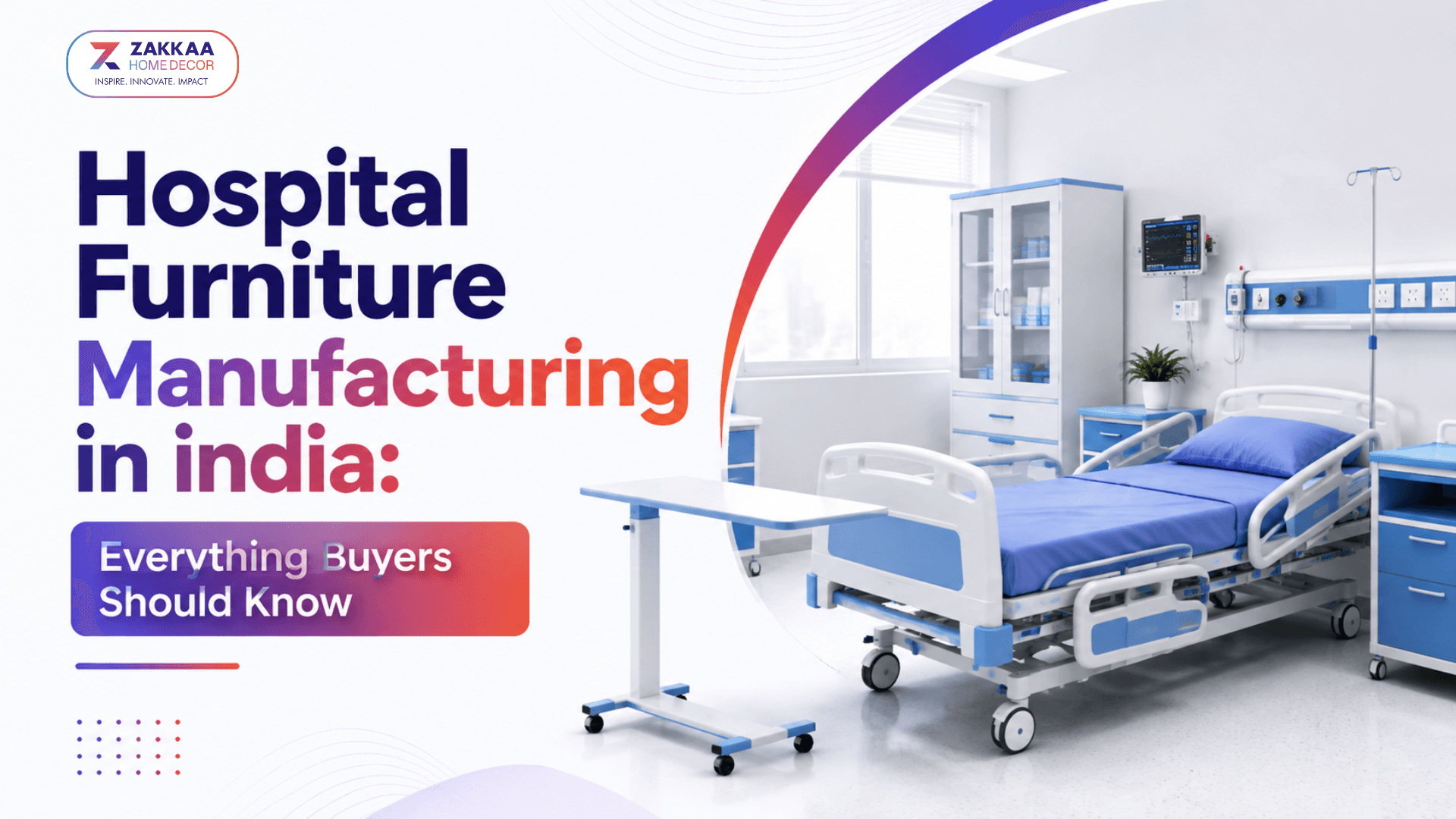
Hospital furniture manufacturing involves designing and producing furniture specifically for healthcare environments. Unlike regular commercial furniture, these products need to account for hygiene, patient safety, frequent cleaning, mobility, durability, and the limited space available in many hospital areas.
Depending on the requirement, manufacturers may produce products such as hospital beds, bedside tables, examination tables, overbed tables, medical trolleys, stools, chairs, cabinets, lockers, waiting-area furniture, and other healthcare storage solutions.
For hospitals, clinics, nursing homes, diagnostic centres, and healthcare institutions, the right furniture should work around the way the facility operates. For example, a bedside cabinet may need easy-access storage for patients, while a medical trolley may need smooth movement and enough space for frequently used supplies.
Different Types of Hospital Furniture You Can Manufacture
Hospital furniture is not limited to patient beds. Different departments require different furniture based on their daily activities and space requirements.
Hospital Beds: Designed for patient accommodation, with sturdy frames and features that support everyday hospital care.
ICU Beds: Specialised patient beds designed for intensive-care environments, supporting monitoring, positioning, and frequent medical interventions.
Bedside Tables: Compact storage units placed beside patient beds for keeping medicines, personal belongings, and daily essentials within reach.
Examination Tables: Used by doctors and medical staff for patient examination, consultation, and basic clinical procedures.
Medical Trolleys: Mobile units used to carry medicines, medical supplies, instruments, and equipment between different hospital areas.
Hospital Cabinets: Provide organised storage for medicines, supplies, equipment, documents, and other items required within healthcare facilities.
Patient Lockers: Secure storage units that allow patients to keep their personal belongings safely during their hospital stay.
Overbed Tables: Adjustable tables positioned over the bed for eating, writing, reading, or other bedside activities.
Waiting Chairs: Seating solutions designed for patients, attendants, and visitors in waiting rooms and common hospital areas.
Stools: Compact seating options commonly used by doctors, nurses, technicians, and other healthcare staff.
Reception Furniture: Includes desks, counters, chairs, and storage solutions used to create functional hospital reception and front-office areas.
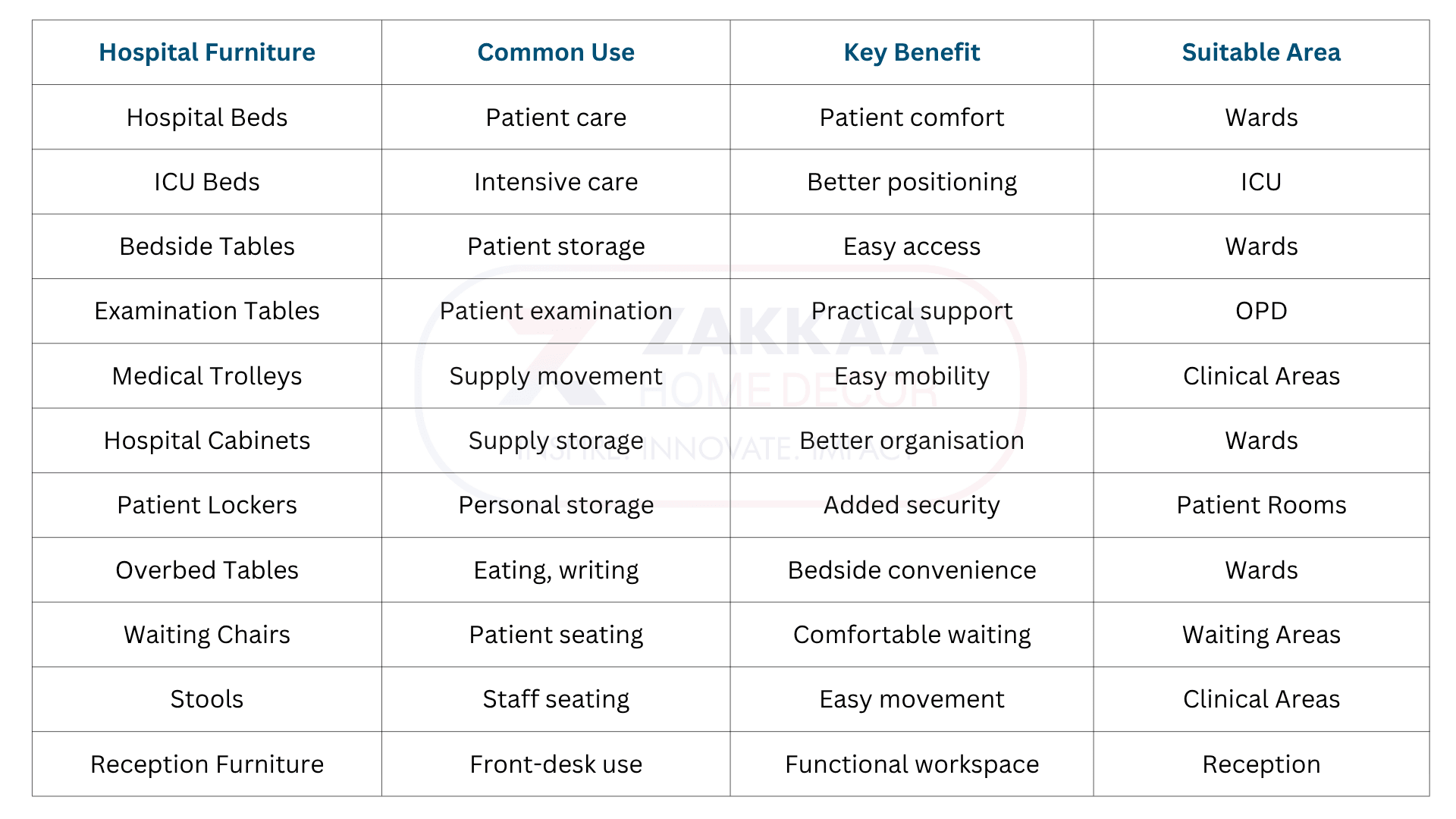
The requirement can also vary between a general ward, ICU, operation theatre, laboratory, outpatient department, or waiting area. This is why buyers should decide where the furniture will be used before finalising specifications.
How Is Hospital Furniture Manufactured? Complete Process
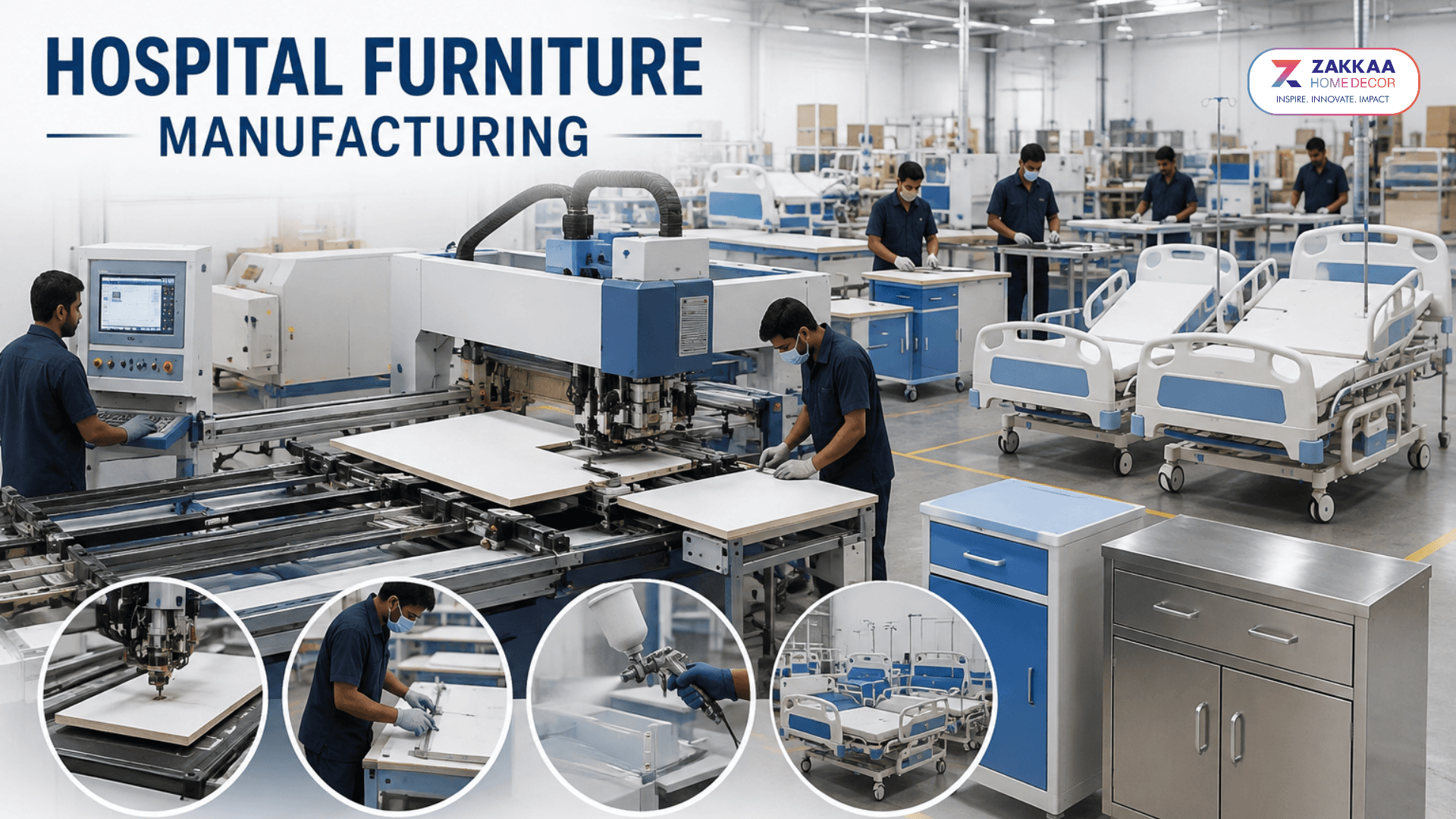
A professional hospital furniture manufacturing process usually moves through several stages, from design and material preparation to fabrication, finishing, assembly, and inspection.
1. Product Design And Specifications
Manufacturing starts with understanding the product requirements. The manufacturer finalises dimensions, load requirements, storage configuration, materials, mobility features, hardware, colour, and other specifications according to the intended application.
For bulk orders, this stage is particularly important because even a small change in dimensions can affect the usability of hundreds of units.
2. Material Selection
The material depends on the product, expected usage, budget, and required durability. Steel is commonly considered for many hospital furniture applications because it provides a strong structural base and can be fabricated into different shapes and configurations.
Other materials may also be used for specific components, such as boards, plastics, stainless steel, foam, upholstery, castors, handles, and other hardware.
The important point for buyers is not simply asking, “Which material is used?” Ask where each material is being used and why it has been selected for that particular product.
3. CNC Cutting And Sheet Metal Fabrication
For steel hospital furniture, sheet metal fabrication is an important part of production. Sheets and metal sections are cut according to approved dimensions before being formed into the required components.
Depending on the product, manufacturing may involve:
CNC laser cutting
Sheet shearing
CNC punching
CNC bending
Tube cutting
Welding and joining
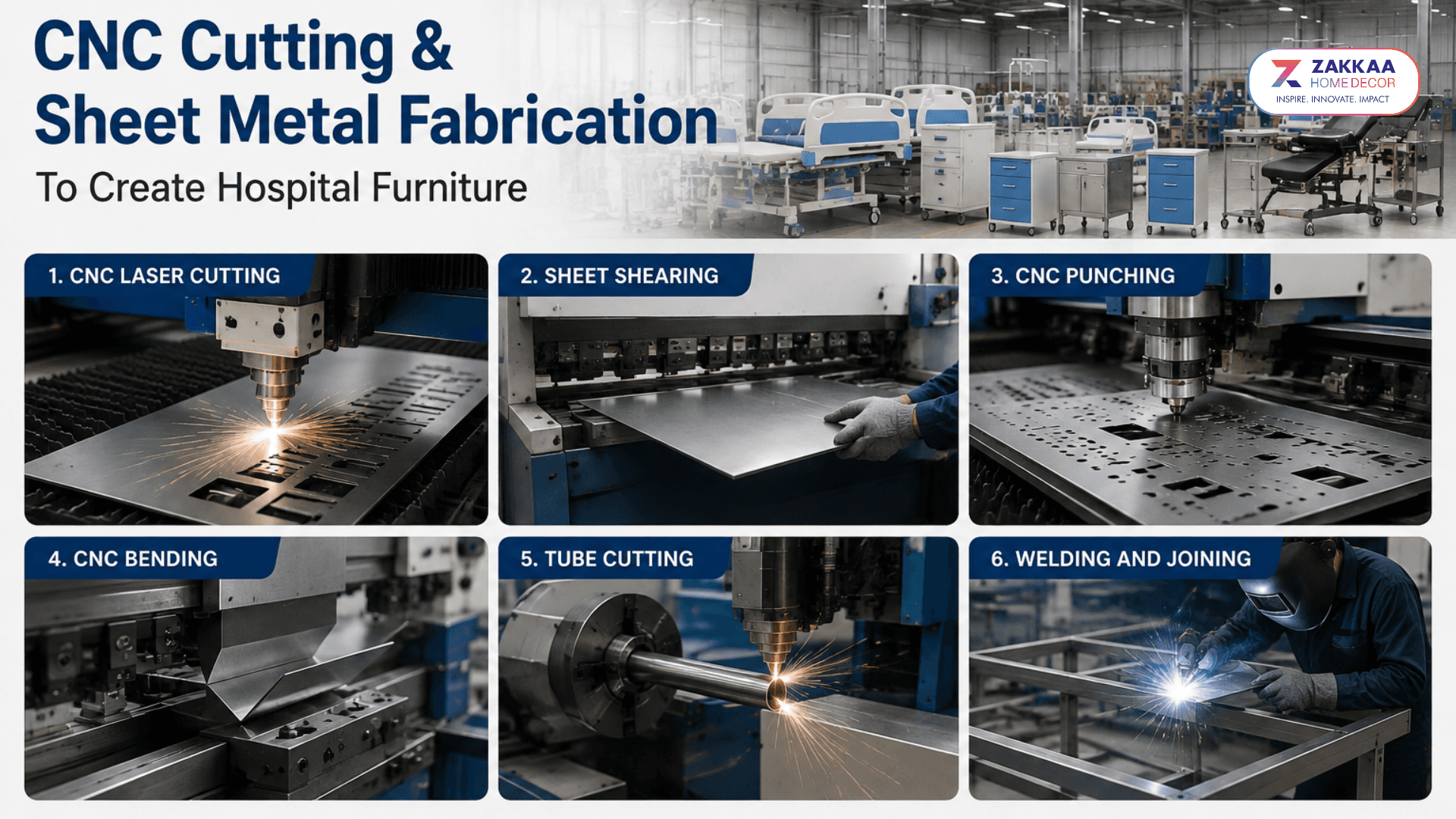
CNC machinery helps manufacturers produce repeatable components, which becomes particularly valuable when hospitals require large quantities of the same product.
4. Welding And Component Joining
Once the metal components are cut and formed, they are joined to create the product structure. Welding quality directly affects the strength and stability of many steel hospital products.
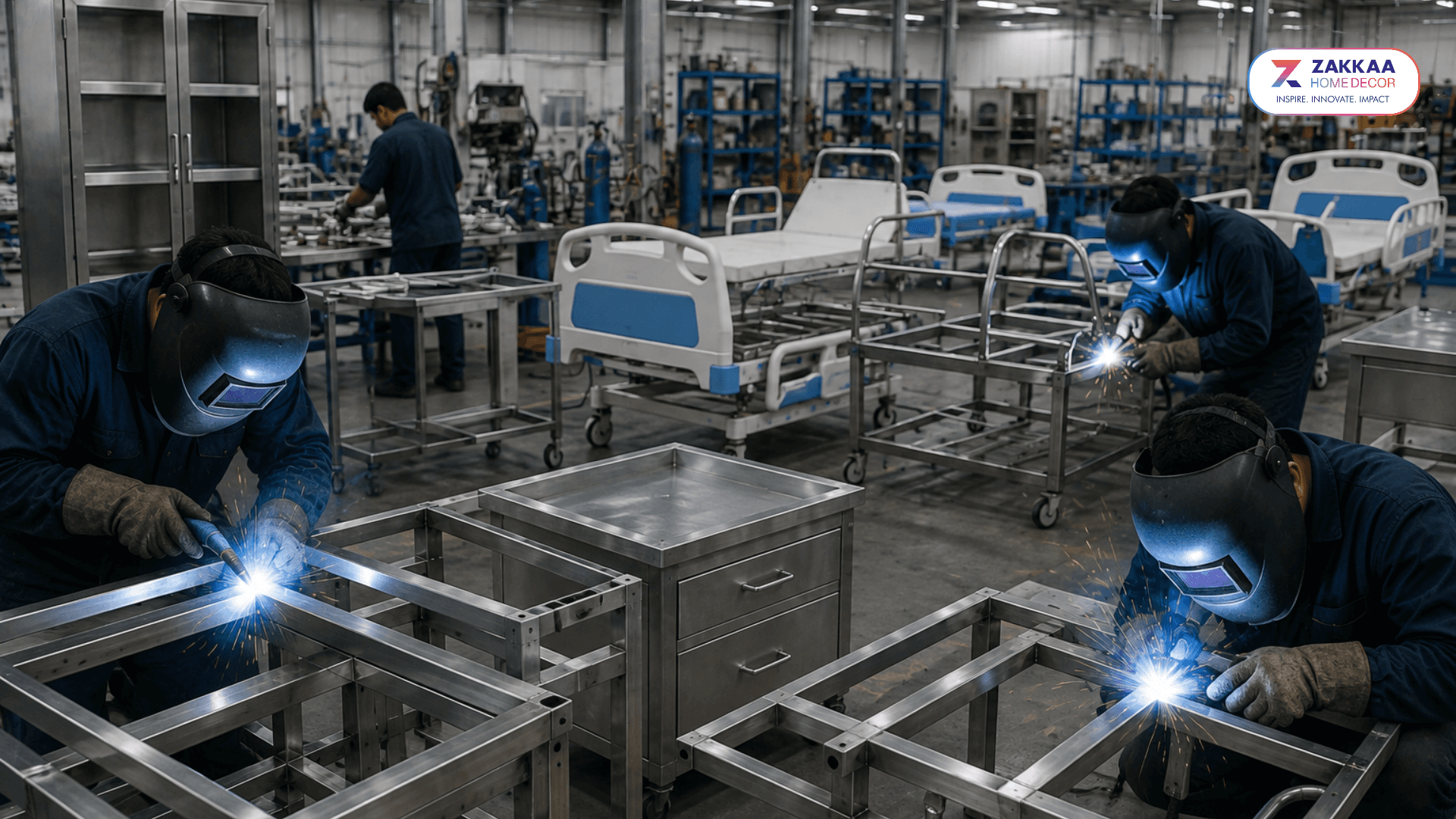
Manufacturers need to pay attention to joint strength, alignment, sharp edges, surface condition, and overall structural stability. Poorly finished joints can become uncomfortable to handle and may create maintenance or safety concerns later.
5. Surface Preparation And Finishing
After fabrication, metal surfaces are prepared for finishing. Depending on the product and manufacturing specification, this can include cleaning, surface treatment, powder coating, or other suitable finishing processes.
For hospital furniture, finishing is more than an appearance-related decision. A properly finished surface should be practical for regular cleaning and should help protect the underlying material from everyday wear.
6. Assembly
Individual components are brought together during assembly. This may include installing shelves, drawers, doors, handles, hinges, castors, locking systems, mattress supports, frames, or other product-specific components.
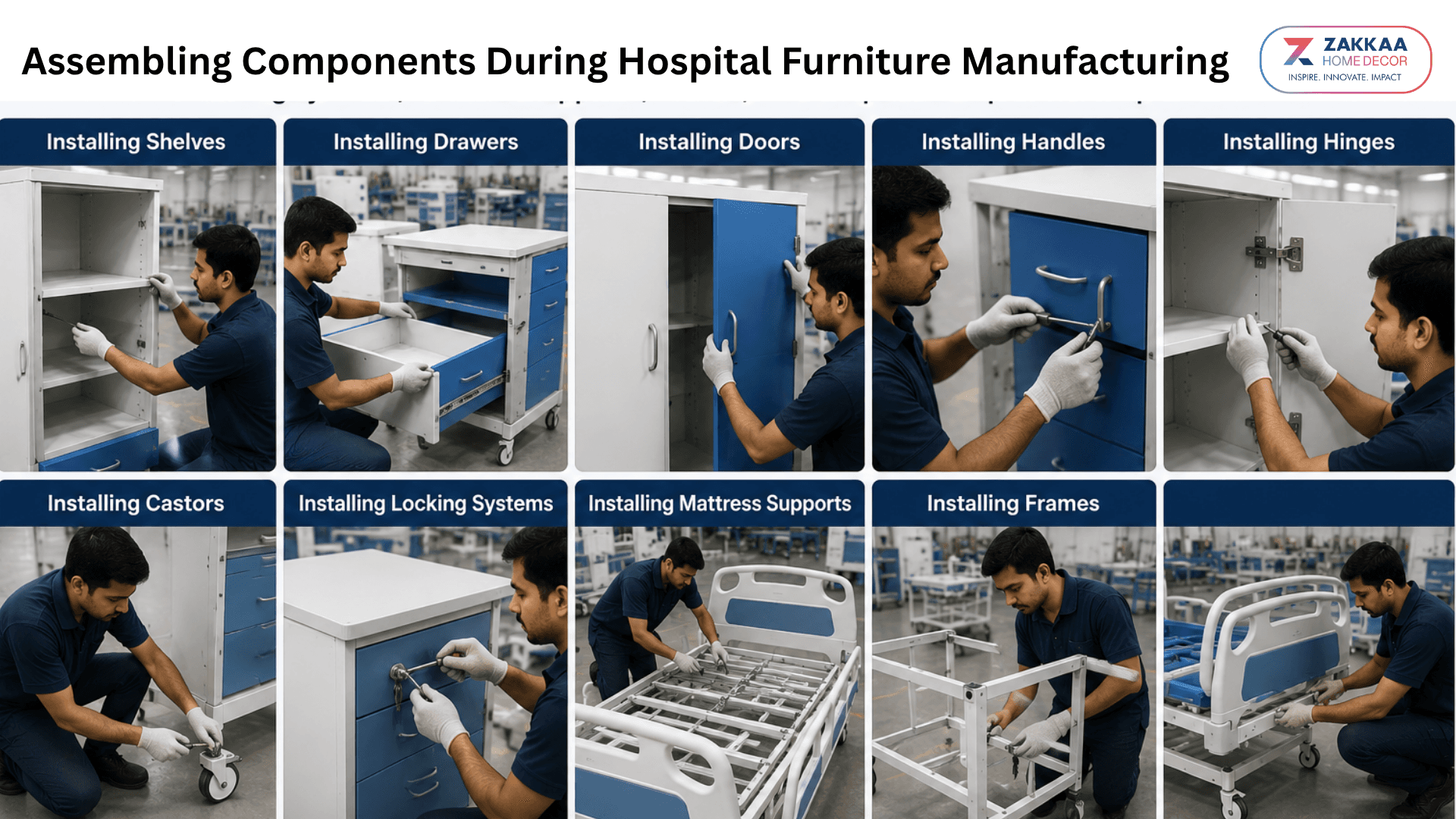
At this stage, manufacturers also check whether moving parts operate properly and whether the assembled product matches the approved design.
7. Quality Inspection And Testing
Before dispatch, finished furniture should go through quality checks. Depending on the product, manufacturers may inspect dimensions, welding, surface finish, stability, movement, hardware, load-bearing performance, and general functionality.
For a bulk hospital order, sample approval and batch-level inspection can also help buyers identify problems before the complete quantity reaches the facility.
8. Packaging And Dispatch
Hospital furniture needs suitable packaging because products can be damaged during loading, transportation, and unloading. Manufacturers generally protect finished surfaces and vulnerable components before dispatching the order.
For large projects, proper labelling and organised dispatch can also make installation and distribution easier once the furniture reaches the hospital.
What Should Buyers Check Before Buying Hospital Furniture?
The lowest quotation is rarely enough to decide whether hospital furniture is a good purchase. A better approach is to compare the product specifications, manufacturing quality, expected usage, and after-sales support together.
Find The Construction
Look closely at the frame, joints, welds, panels, legs, handles, drawers, and other structural components. Furniture intended for continuous hospital use should feel stable rather than lightweight or poorly assembled.
Check The Dimensions
A product can be well made and still be unsuitable if its dimensions do not work within the hospital environment. Check height, width, depth, clearance, and movement requirements before placing a bulk order.
Consider Cleaning And Hygiene
Hospital furniture is cleaned frequently, so surfaces should be practical to maintain. Avoid unnecessarily complicated designs that create difficult-to-reach areas where dust, spills, or other contaminants can accumulate.
Check Mobility
For trolleys, beds, stools, and movable tables, castors and movement mechanisms deserve particular attention. Smooth movement, stable construction, and suitable locking mechanisms can make everyday staff operations easier.
Examine Storage Design
Cabinets, bedside tables, lockers, and medical storage furniture should provide useful access rather than simply offering more compartments. Consider what will actually be stored and how frequently staff or patients will need to reach it.
Ask About Customisation
Every healthcare facility has different floor plans and operational requirements. A manufacturer capable of modifying dimensions, storage layouts, colours, configurations, or branding can be more useful than a supplier offering only fixed models.
Standard Vs Customized Hospital Furniture: Key Differences Explained
Standard hospital furniture is ready-made with fixed specifications, while customized hospital furniture is manufactured around your specific space, usage, and design requirements. The right choice depends on whether your hospital needs commonly available products or furniture that fits a particular room layout, storage requirement, or operational need.
Standard furniture can be a practical choice when you need faster procurement and straightforward specifications. Customized furniture, however, gives you more control over dimensions, compartments, materials, colours, branding, and other details, making it useful for hospitals with specific functional requirements.
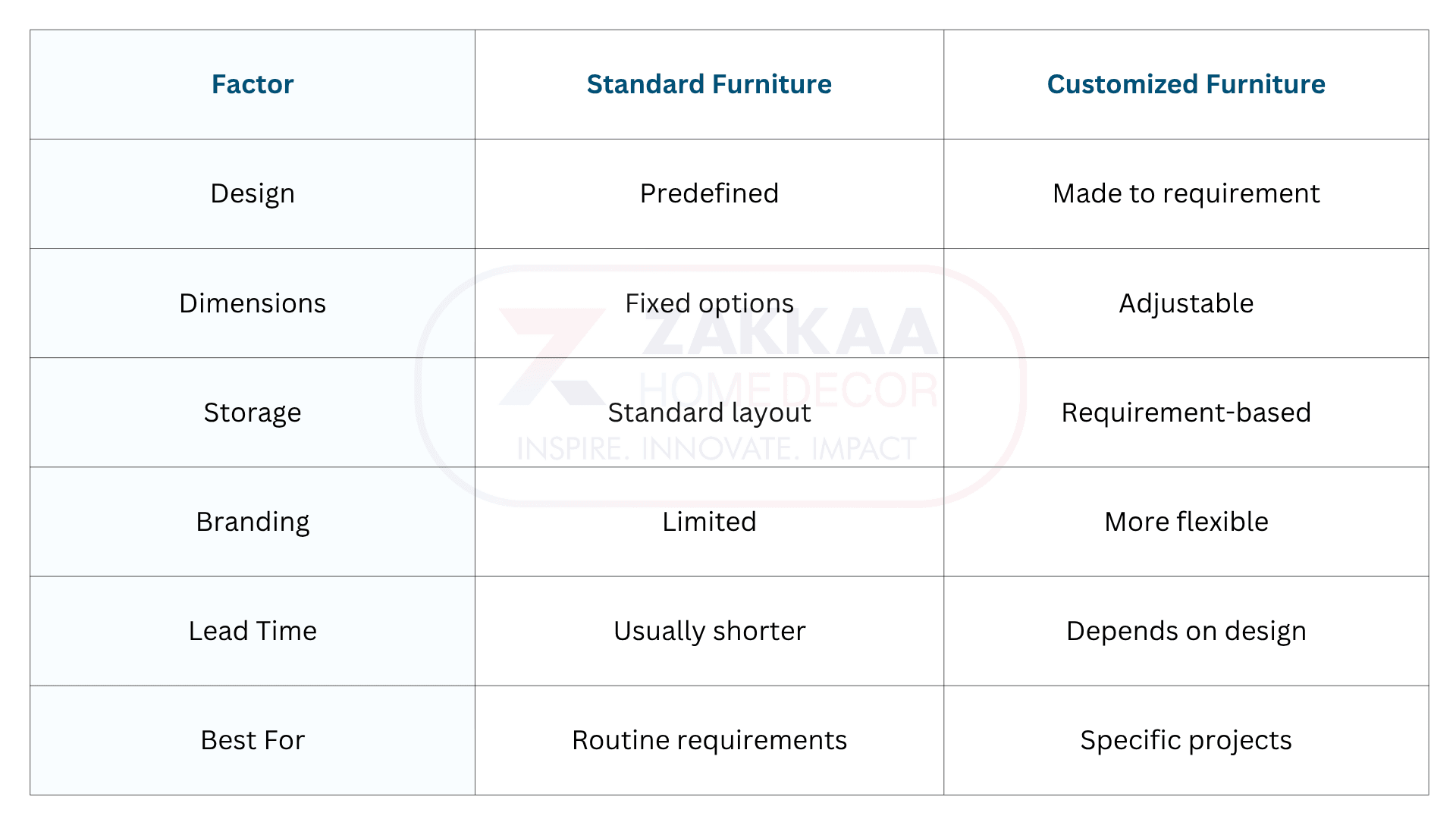
For a large hospital project, a practical approach can be to standardise products wherever possible and customise only those items where the facility genuinely needs a different configuration.
Why OEM Hospital Furniture Manufacturing Can Be Better For Bulk Buyers
Buying directly from an OEM hospital furniture manufacturer can give hospitals and healthcare businesses greater control over product specifications and production.
Instead of selecting whatever inventory is already available, buyers can discuss dimensions, materials, storage configurations, finishes, hardware, and quantities with the manufacturing team.
OEM manufacturing can also be useful for projects involving large quantities. Once the design is approved, the manufacturer can produce the required units according to the agreed specifications, helping the buyer maintain a more uniform setup throughout different rooms or departments.
For healthcare groups operating multiple facilities, this can be particularly useful when the same furniture design needs to be reproduced across different locations.
Factors Affecting Hospital Furniture Manufacturing Cost
Hospital furniture prices depend on much more than the amount of metal or material used. The final cost can be influenced by:
Product size and design complexity
Material type and thickness
Hardware and accessories
Number of drawers, shelves, or compartments
Castors and mobility systems
Surface finishing
Upholstery or cushioning
Customisation requirements
Order quantity
Packaging and transportation
Testing and quality requirements
For example, a basic steel cabinet and a mobile medical trolley may use similar fabrication processes but have very different costs because their hardware, mobility components, assembly, and functional requirements differ.
This is why bulk buyers should compare quotations against detailed specifications rather than choosing a manufacturer simply because its initial price is lower.
How To Choose A Hospital Furniture Manufacturer In India?
The selection of a hospital furniture manufacturer should go beyond comparing catalogues and quotations. Look at the manufacturer's production capabilities, quality practices, customisation support, and ability to deliver the same specifications across your entire order.
Check Manufacturing Capacity
Make sure the manufacturer has enough production capacity to handle your required quantity within the agreed timeline, especially for large hospital projects.
Ask For A Physical Sample
A sample lets you check the actual dimensions, construction, finish, hardware, storage, movement, and overall usability before approving the complete production.
Look For Customisation Support
If your hospital needs specific dimensions, layouts, storage configurations, colours, or branding, choose a manufacturer that can accommodate these requirements.
Understand The Quality Process
Find out how the manufacturer checks materials, fabrication, welding, finishing, assembly, dimensions, and final products before they leave the facility.
Review Warranty And Support
Discuss what support is available if furniture arrives damaged or develops a manufacturing issue, including repairs, replacements, warranty coverage, and service.
Consider Future Requirements
If you may expand the hospital or open additional branches, choose a manufacturer capable of reproducing the same approved specifications for future orders.
Why Choose Zakkaa For Hospital Furniture Manufacturing?
Zakkaa is an Indian OEM manufacturer with manufacturing capabilities suited to businesses looking for reliable, specification-based furniture production. For hospital and healthcare requirements, the focus can be placed on product design, sheet metal fabrication, component assembly, finishing, quality inspection, and bulk production according to the approved specifications.
For buyers, the advantage of working with an OEM manufacturer is the ability to discuss the actual requirement instead of adapting the entire project around whatever products happen to be available. Whether the requirement involves standard hospital furniture or a customised configuration, clear specifications and sample approval can help create a smoother production process.
For bulk healthcare projects, Zakkaa can work with buyers on product requirements, quantities, customisation, and manufacturing needs, making it easier to plan furniture procurement around the facility's actual requirements.
Final Checklist For Hospital Furniture Buyers
Before placing a bulk order, make sure you have confirmed:
Product dimensions and drawings
Material specifications
Sheet thickness, where applicable
Surface finishing requirements
Load and usage requirements
Hardware and accessories
Castors and locking mechanisms
Storage configuration
Colour and branding requirements
Sample approval
Quantity and production timeline
Packaging requirements
Delivery terms
Warranty and after-sales support
Quality inspection process
Final Remarks
Hospital furniture has to work in a demanding environment where durability, hygiene, usability, safety, and maintenance all matter.
A good purchasing decision therefore starts before the quotation stage, with clear specifications, suitable materials, practical designs, and a manufacturer capable of delivering the required quantity without compromising the approved product standard.
For hospitals, clinics, nursing homes, and healthcare projects buying in bulk, working directly with an experienced hospital furniture manufacturer can also make customisation and production planning easier.
If you are planning a healthcare furniture project, connect with a trusted OEM hospital furniture manufacturer in India to discuss your furniture requirements and develop products around your specific needs.
Frequently Asked Questions (FAQs)
What Is The Lifespan of Hospital Furniture?
Well-made hospital furniture can last for years, depending on material quality, frequency of use, maintenance, and the environment where it is installed.
Can Hospital Furniture Be Made According To Room Dimensions?
Yes, manufacturers can modify dimensions and configurations to suit available space, especially for storage units, tables, cabinets, and other fixed furniture.
Is Powder Coating Suitable For Hospital Furniture?
Powder coating can provide a durable, smooth finish that is practical for many steel furniture applications and easier to maintain during regular cleaning.
How Can Hospitals Maintain Their Furniture?
Regular cleaning, timely tightening of loose hardware, checking moving parts, and addressing surface or structural damage early can help extend furniture life.
Can Hospitals Order Furniture With Their Logo?
Yes, branding options can be discussed with the manufacturer for suitable products, including selected colours, logos, labels, or other approved identification details.
What Is The Minimum Order Quantity For Hospital Furniture?
Minimum quantities depend on the manufacturer and product. Bulk requirements are generally discussed according to the design, production capacity, and level of customisation required.
Can A Manufacturer Replicate An Approved Furniture Sample?
Yes, an approved sample or technical drawing can serve as the production reference, helping the manufacturer reproduce the agreed dimensions, materials, finish, and configuration.
What Should Be Included In A Hospital Furniture Quotation?
A quotation should clearly mention product specifications, material details, dimensions, quantity, finishing, accessories, delivery timeline, applicable taxes, warranty, and other agreed terms.