Aug 28, 202612 min readBy Aditya Singh
School furniture gets tested every day in ways ordinary furniture rarely does. Chairs are moved repeatedly, desks take constant wear, surfaces need frequent cleaning, and hundreds of students may use the same furniture throughout the academic year.
For procurement teams and school decision-makers, that makes durability only one part of the equation. Because buying 500 school desks is not simply the same as buying one desk 500 times.
At that scale, a small difference in dimensions, material quality, finish, or construction can affect an entire classroom, and replacing unsuitable furniture later can become an expensive exercise.
This is why schools need to evaluate the furniture manufacturing side as carefully as the price quoted by a supplier.
This guide covers the manufacturing process, important quality and design considerations, bulk purchasing factors, and what schools should evaluate before committing to an institutional furniture supplier.
What Is Institutional Furniture?
Institutional furniture is designed for organisations such as schools, colleges, universities, hospitals, offices, hostels, and other institutions. Unlike household furniture, it is typically built for repeated daily use by multiple people and must suit the practical requirements of the environment where it is installed.
In schools, institutional furniture can include student desks and chairs, two-seater desks, benches, teacher tables and chairs, computer tables, library furniture, storage cupboards, steel almirahs, reception furniture, storage cabinets, laboratory tables, notice boards, and book racks.
Each type serves a specific purpose, from supporting classroom learning and storage to creating organised library, laboratory, reception, and administrative spaces.
For bulk procurement, institutions can select furniture based on their functional requirements, durability expectations, space constraints, and planned usage.
What Should You Look For Before Buying Institutional Furniture In Bulk?
When purchasing 50, 100, 500, or more furniture units, small differences in quality can become significant. A chair that seems fine during a showroom visit may not perform the same way after years of daily classroom use.
Before placing a bulk order, evaluate the following.
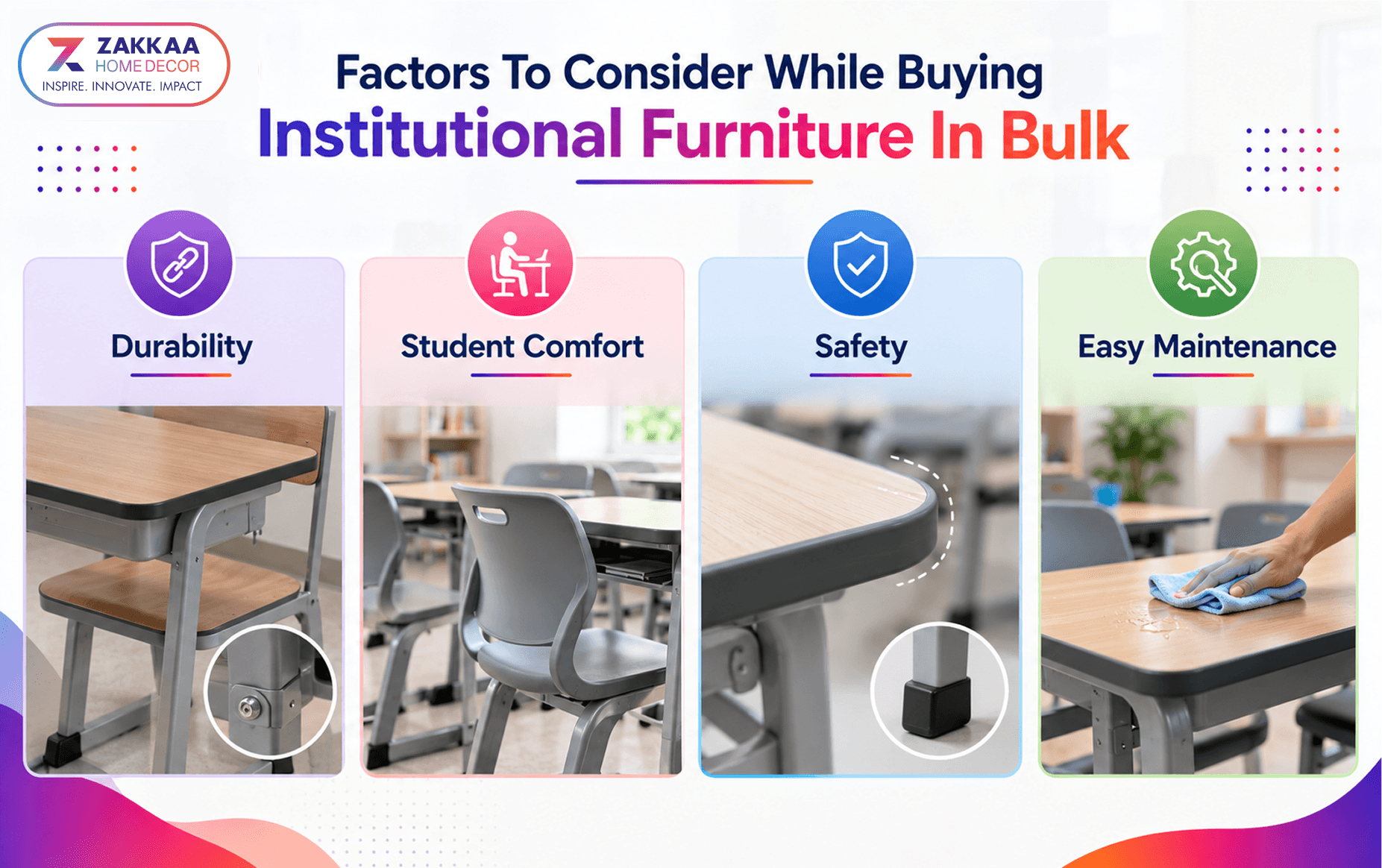
1. Durability
School furniture experiences repeated use every day. Students move chairs, open storage units, lean on desks, and frequently shift furniture around classrooms.
Look for sturdy construction, reliable joints, suitable materials, strong legs, and surfaces that can withstand regular use.
For metal furniture, check the sheet thickness, frame construction, welding quality, and surface finish rather than judging strength only by appearance.
2. Student Comfort
Furniture should suit the age and size of the students using it.
A desk that is too high can make writing uncomfortable, while an unsuitable chair height can affect sitting posture.
For schools, consider:
Seat height
Desk height
Seat depth
Backrest design
Legroom
Desk space
Edge design
Different furniture sizes may be required for primary, middle, and senior classes.
3. Safety
School furniture should not have sharp edges, unstable frames, exposed hazardous components, or loose fittings.
Rounded or properly finished edges, stable construction, secure fasteners, and smooth surfaces can reduce common safety concerns.
For bulk procurement, ask the manufacturer how furniture is inspected before dispatch.
4. Easy Maintenance
Schools cannot afford to spend excessive time maintaining classroom furniture.
Choose surfaces that are easy to wipe and materials that can handle regular cleaning. Furniture should also allow straightforward replacement or repair of commonly damaged components where possible.
This becomes particularly valuable when managing hundreds of units across multiple classrooms.
Which Materials Are Used In School Furniture Manufacturing?
There is no single material suitable for every school furniture requirement.
Steel
Steel is widely used for institutional furniture because it can provide a strong structure for desks, chairs, cupboards, storage units, and other products.
Proper surface treatment and finishing can also help protect steel furniture from everyday wear and corrosion.
Wood And Engineered Boards
Wood, plywood, MDF, particle board, and other engineered materials can be used for desks, tables, cabinets, shelves, and classroom furniture.
The appropriate material depends on the furniture's intended use, design, budget, and expected service life.
Plastic
Plastic components can be useful for student chairs, seats, backs, and other lightweight furniture applications. They are generally easy to clean and can be suitable for younger students when properly designed.
Combination Construction
Many institutional products combine materials. For example, a school desk may use a metal frame with a board-based writing surface, while a chair may combine a metal structure with a moulded seat and backrest.
The important point is to evaluate the complete construction, not simply the material name.
How Is Institutional Furniture Manufactured?
A professional institutional furniture manufacturing process involves several stages, from understanding the buyer's requirements to producing, finishing, inspecting, and packing the final furniture. For schools, the process needs extra attention to dimensions, stability, safety, durability, and the ability to handle repeated daily use.
1. Product Design And Specification
Manufacturing starts with defining exactly what needs to be produced. The manufacturer finalises the furniture dimensions, material, structure, storage requirements, finish, and other specifications based on its intended use.
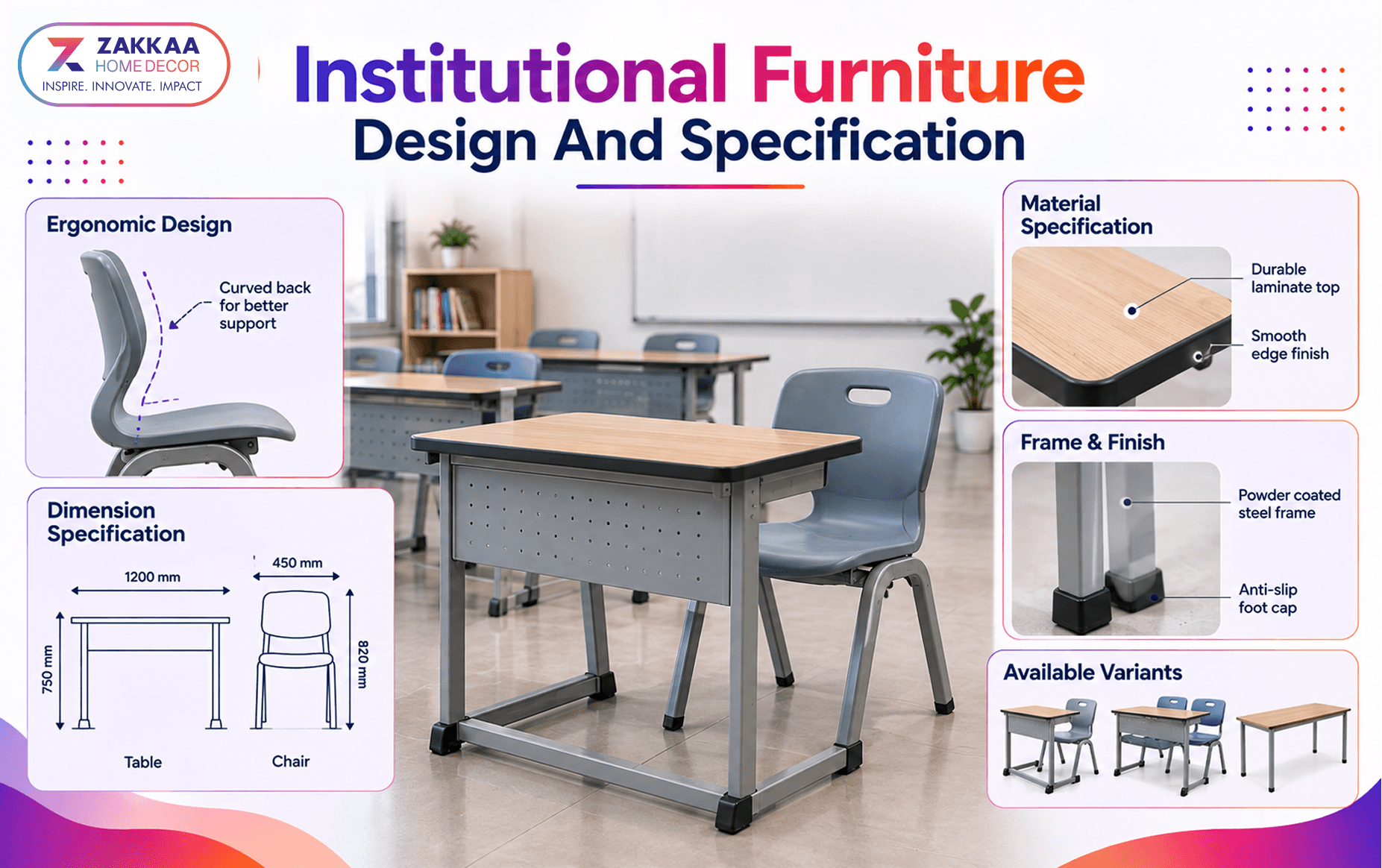
For school furniture, desk and chair dimensions may be planned according to different student age groups. For bulk or OEM orders, the design can also be developed around the buyer's specific requirements.
2. Material Selection And Preparation
Once the design is approved, the required materials are arranged for production. Depending on the product, these may include steel sheets, pipes, boards, plastic components, fasteners, hinges, handles, and other hardware.
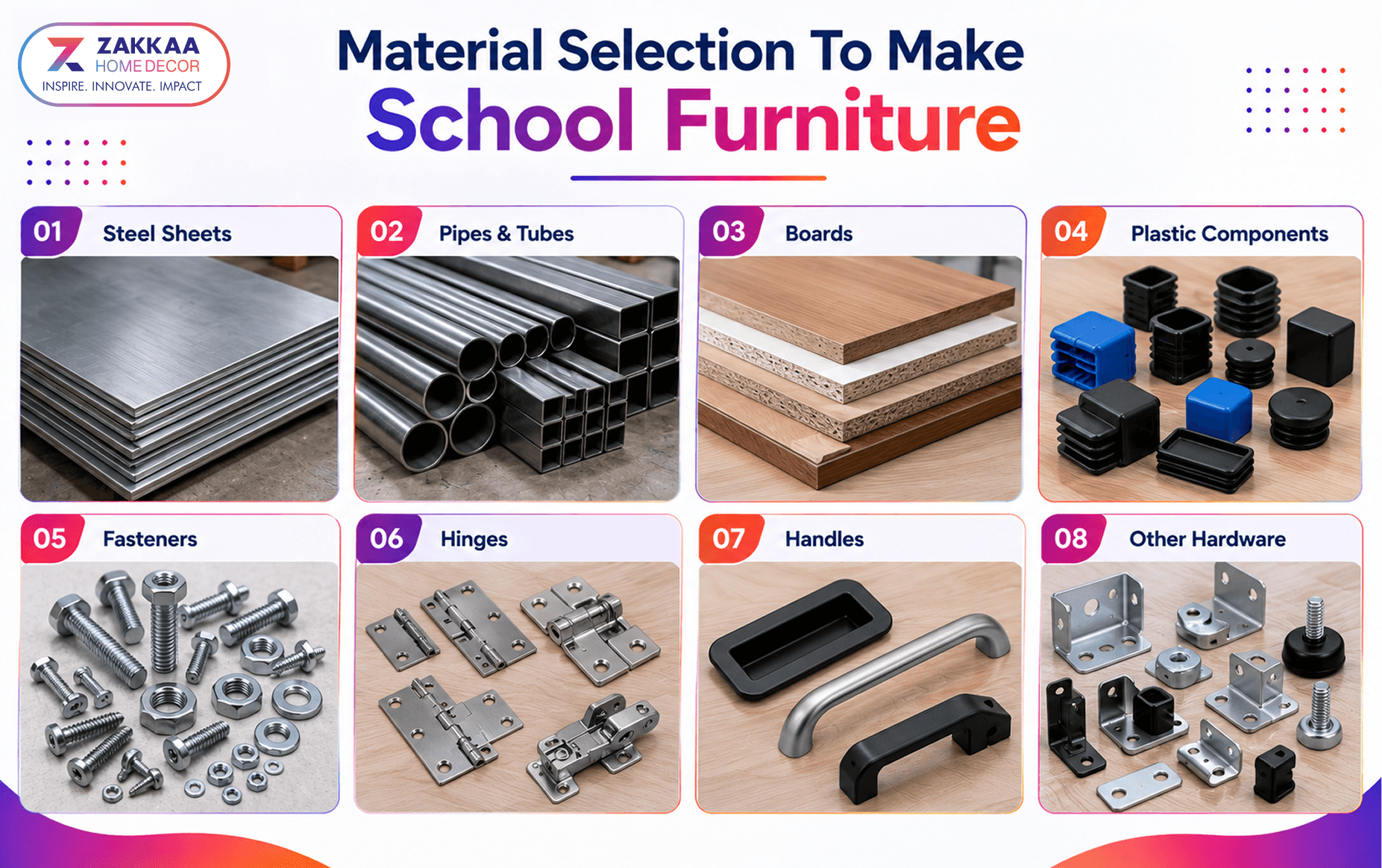
The manufacturer checks the material specifications before fabrication because material quality directly affects the strength, appearance, and service life of the finished furniture.
3. CNC Cutting And Sheet Metal Fabrication
For metal institutional furniture, sheets and other metal components are cut according to the approved drawings. CNC laser cutting can be used to produce precise panels, holes, slots, brackets, and other components.
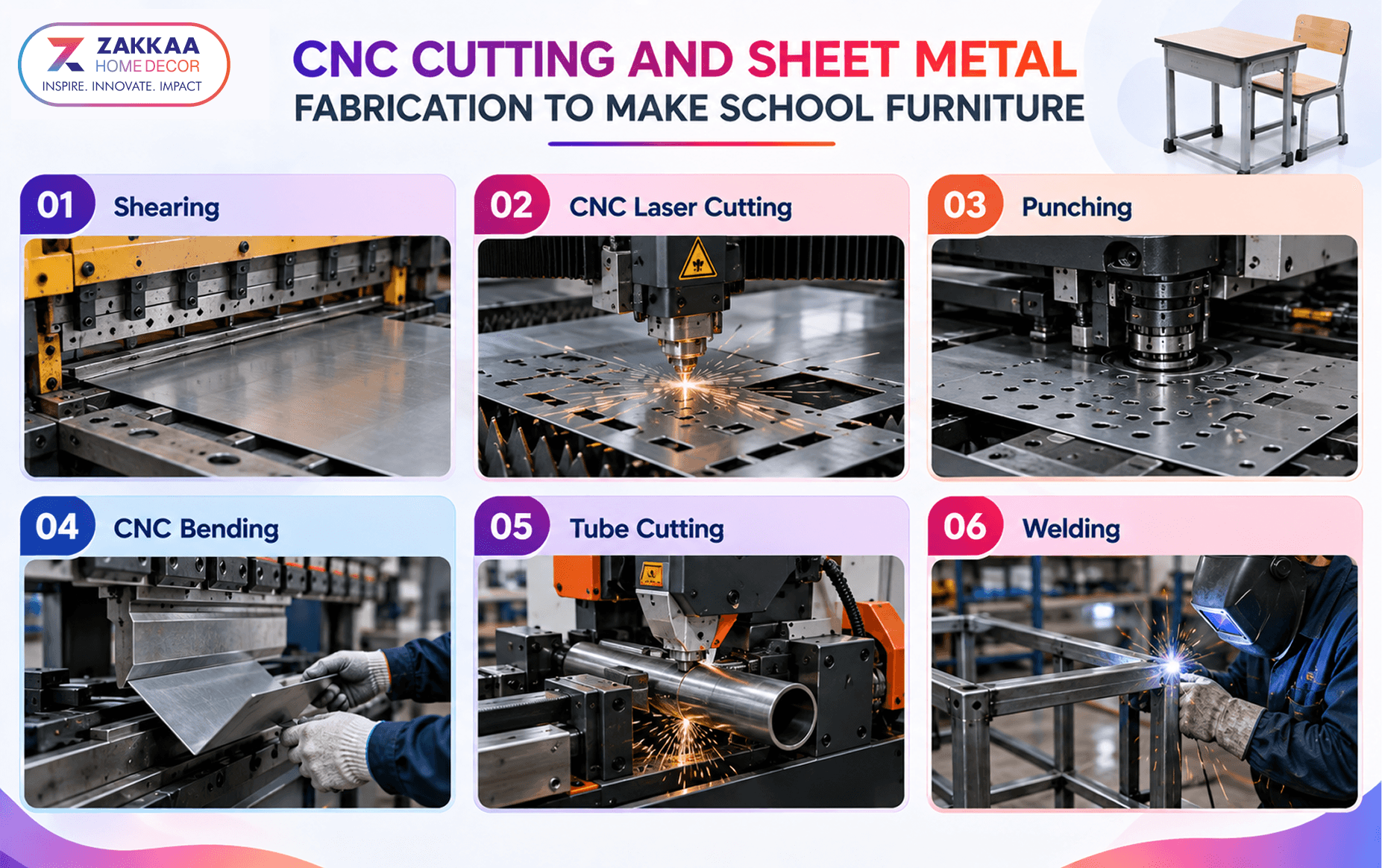
Depending on the design, the manufacturing process may also include:
Shearing: Cuts metal sheets into required dimensions.
CNC Laser Cutting: Produces accurate shapes and openings from digital drawings.
Punching: Creates holes and specific cut-outs in metal components.
CNC Bending: Forms sheets into the required angles and shapes.
Tube Cutting: Cuts pipes or tubes according to specified lengths.
Welding: Joins metal components to create strong frames and structures.
These processes help maintain dimensional accuracy and make it easier to achieve consistent production across large orders.
4. Component Assembly
After fabrication, individual components are brought together to create the furniture.
For example, a school desk may require a frame, legs, writing surface, support brackets, fasteners, and other components. A storage cupboard may require panels, shelves, doors, hinges, handles, and a locking system.
During assembly, the manufacturer checks alignment, stability, joint strength, fitting accuracy, and movement of components to ensure the furniture functions as intended.
5. Surface Preparation And Finishing
Metal components generally undergo surface preparation before the final finish is applied. Depending on the product specification, the manufacturer may use powder coating or another suitable finishing method.
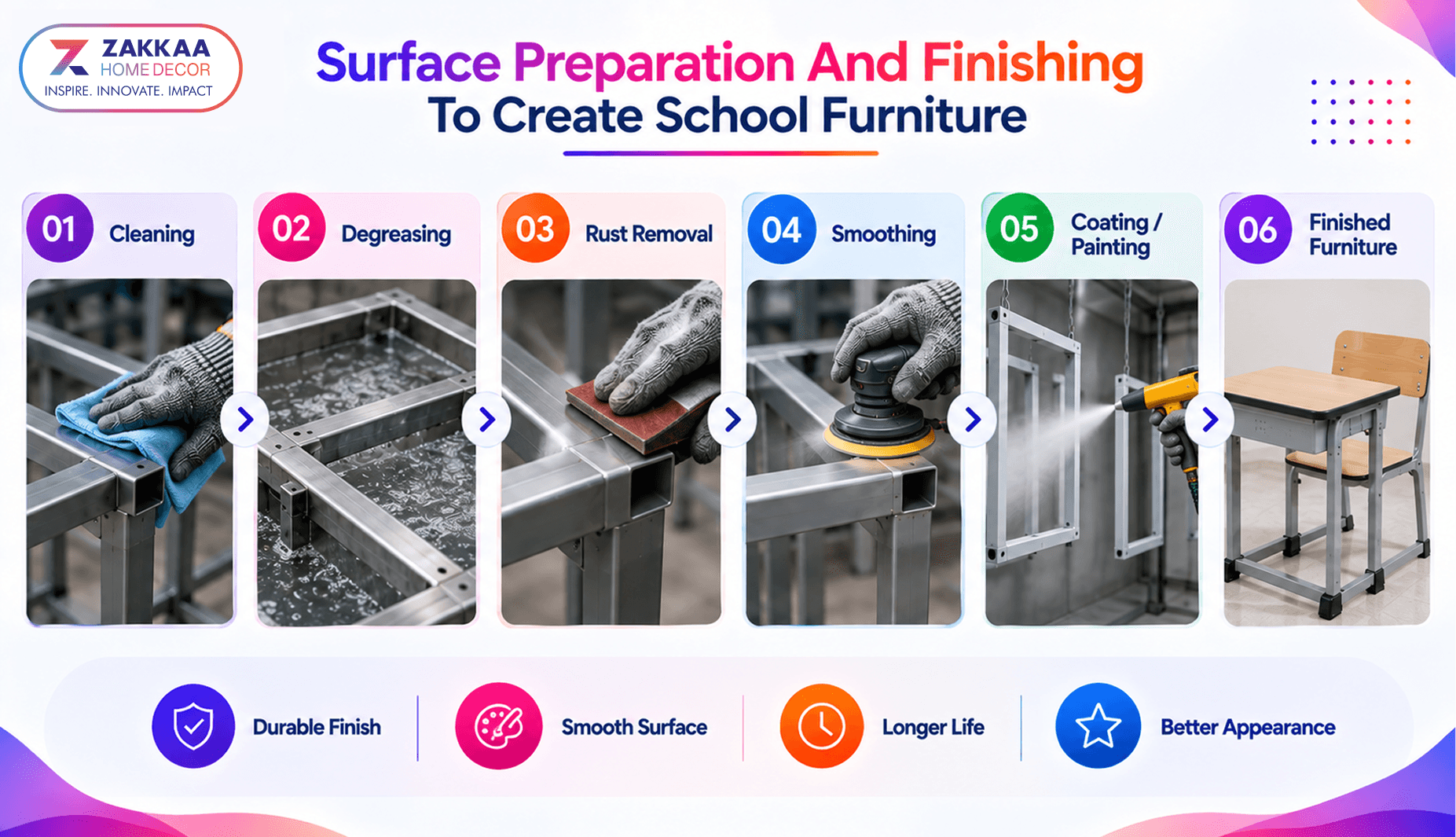
A properly applied finish improves the furniture's appearance while providing a protective layer against everyday wear and environmental exposure.
For institutional orders, buyers can also specify the required colour or finish where customisation is available.
6. Final Assembly And Functional Checks
After finishing, components are assembled into the final product. The manufacturer checks whether doors open properly, drawers move correctly, desks remain stable, and chairs sit firmly on the floor.
This stage helps identify problems such as loose fittings, misalignment, uneven legs, damaged surfaces, or incorrect assembly before the product moves to final inspection.
7. Quality Inspection
Quality inspection is carried out before the furniture is approved for dispatch. Inspectors can check dimensions, construction, welds, surface finish, stability, fittings, functionality, and visible defects against the approved specifications.
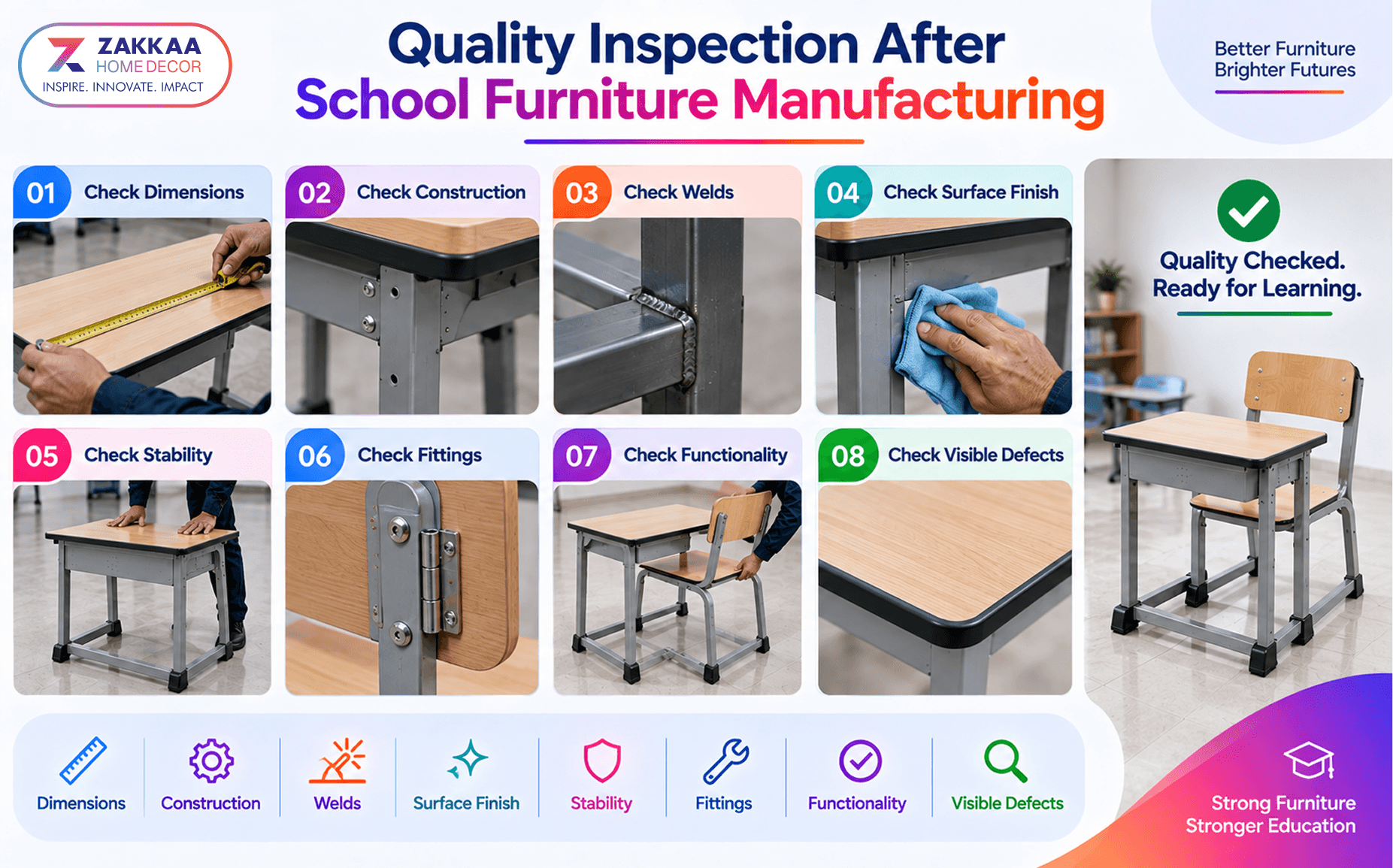
For bulk school orders, batch consistency is particularly important. The first sample and subsequent production units should follow the same approved specifications so that hundreds of desks, chairs, or storage units maintain the expected quality.
8. Packaging And Dispatch
Once the furniture passes inspection, it is prepared for transportation. Appropriate packaging helps protect finished surfaces and components from scratches, dents, moisture, and handling damage during transit.
For large school projects, the manufacturer also needs to coordinate quantity, packing method, dispatch schedule, and delivery requirements so that furniture reaches the institution in usable condition.
In short, institutional furniture manufacturing is a controlled process where design, material selection, CNC fabrication, assembly, finishing, inspection, and packaging all contribute to the quality of the final product.
How To Choose School Desks And Chairs?
The right classroom furniture depends heavily on the students who will use it.
For primary classrooms, prioritise suitable height, rounded edges, stability, easy cleaning, and comfortable seating.
For middle and senior classes, students generally require larger writing surfaces, appropriate legroom, and furniture dimensions suited to their age group.
For computer rooms, laboratory areas, and activity rooms, the furniture should be selected around the equipment and activities being performed rather than simply using standard classroom desks.
If a school has multiple age groups, ordering one universal desk and chair size may not be the best approach.
Custom School Furniture Vs Standard Furniture: Key Differences
Standard furniture can be a good choice when a school needs commonly available dimensions and wants straightforward procurement.
Custom furniture becomes more useful when the institution has specific requirements.
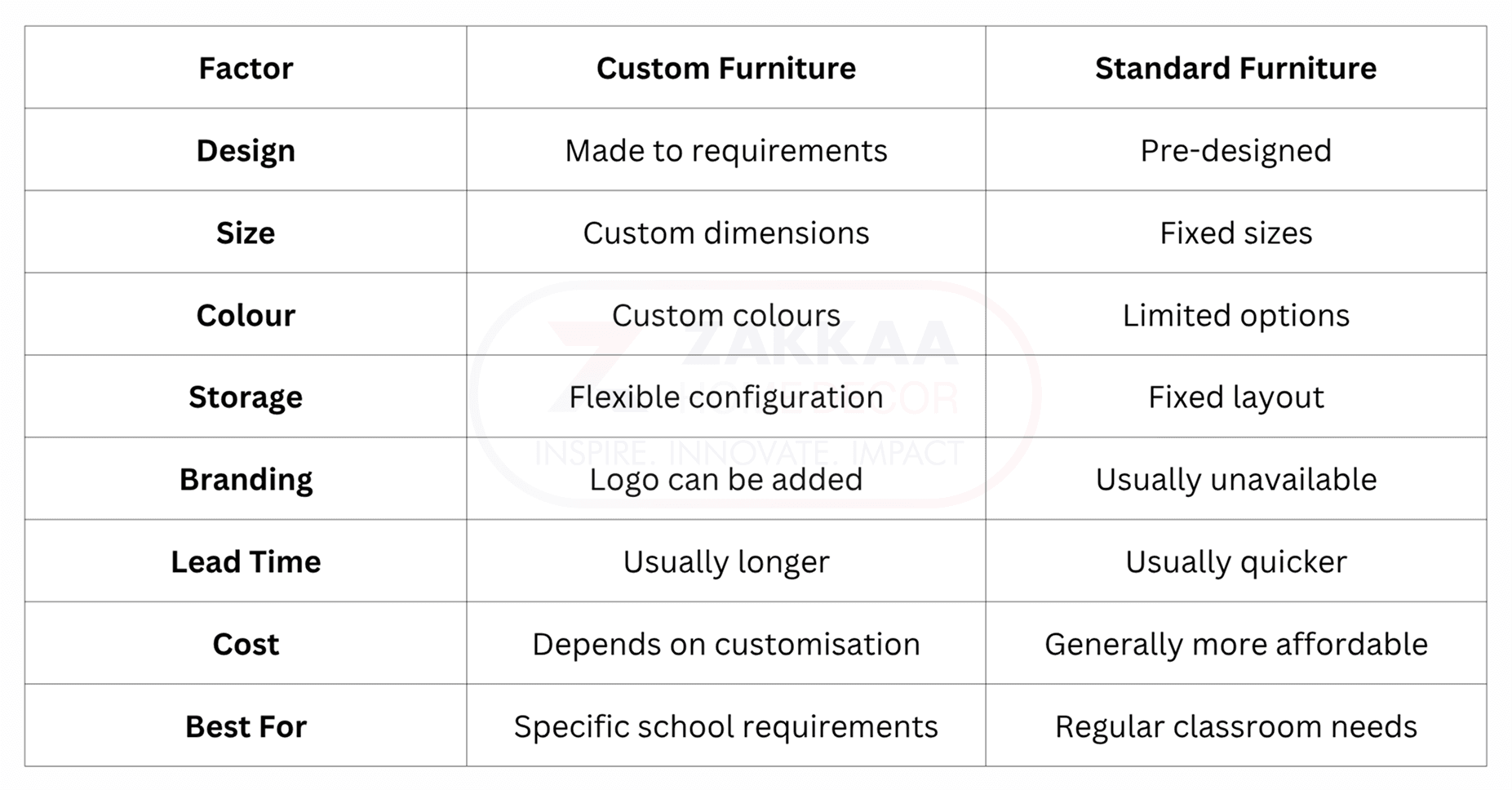
For example, a school may require:
Specific desk dimensions
Different student sizes
School-specific colours
Custom branding
Additional storage
Special classroom layouts
Specific material combinations
Custom packaging
For large orders, discuss these requirements with the manufacturer before production begins. Customisation may affect tooling, material procurement, production timelines, and pricing.
What Should You Ask A School Furniture Manufacturer?
Before finalising a bulk supplier, ask practical questions rather than relying only on a catalogue.
Can you manufacture the required quantity?
Confirm the manufacturer's production capacity and expected delivery schedule.
Can you provide samples?
A physical sample allows the school to check dimensions, comfort, construction, finish, and overall quality before approving bulk production.
Can the design be customised?
Ask about dimensions, colours, branding, materials, storage, and other modifications.
What quality checks are performed?
Understand how raw materials, fabrication, assembly, finishing, and final products are inspected.
How are bulk orders packaged?
Proper packaging can reduce scratches, dents, and damage during transportation.
Do you support replacement or after-sales requirements?
This is particularly important when purchasing hundreds of units.
Practical Tips For Successful Bulk Furniture Buying For Schools
Bulk furniture buying requires more planning than purchasing a few individual pieces. Schools should evaluate quality, student comfort, quantities, specifications, delivery, and after-sales support before finalising a large order. These practical tips can help you avoid costly mistakes and make the procurement process smoother.
1. Prepare A Detailed Requirement List
List every furniture type, required quantity, dimensions, material, colour, and other specifications before requesting quotations.
2. Order A Sample First
Check an actual sample for comfort, stability, construction, finish, and overall quality before approving bulk production.
3. Compare Complete Quotations
Compare material specifications, transportation, packaging, taxes, warranty, and other costs instead of looking only at unit price.
4. Check Manufacturing Capacity
Make sure the manufacturer can produce the required quantity within your school's expected delivery timeline.
5. Confirm Quality Standards
Ask about material quality, fabrication methods, finishing process, inspection procedures, and quality checks for bulk production.
6. Consider Student Requirements
Select suitable desk and chair dimensions based on students' age groups, classroom activities, and available space.
7. Discuss Customisation Early
If you need specific colours, dimensions, branding, storage, or designs, confirm these requirements before production begins.
8. Clarify Delivery And Support
Confirm delivery schedules, packaging, installation requirements, warranty coverage, and replacement support before placing the final order.
Why Choose An OEM Institutional Furniture Manufacturer?
Schools and institutional buyers often need furniture in large quantities with specific dimensions and designs. An OEM manufacturer can produce furniture according to an approved specification instead of limiting the buyer to standard retail models.
This can be useful for:
School chains
Educational institutions
Government projects
Furniture distributors
Education infrastructure companies
Institutional procurement agencies
Private-label furniture brands
OEM manufacturing can allow buyers to specify materials, dimensions, finishes, colours, configurations, and quantities according to their project requirements.
Moreover, Zakkaa is an Indian OEM manufacturer with manufacturing capabilities for institutional and sheet metal furniture requirements. For bulk buyers, the focus is not simply on supplying furniture but on producing according to defined specifications and project requirements.
Our manufacturing capabilities support sheet metal fabrication, CNC-based processes, assembly, finishing, and quality inspection, allowing institutional buyers and brands to develop furniture products according to their required configurations.
For schools purchasing in bulk, this can be useful when standard market furniture does not match the required dimensions, storage configuration, finish, or quantity. OEM manufacturing also provides an opportunity to create furniture ranges for different classrooms, age groups, and institutional spaces.
Final Thoughts
To conclude, buying institutional furniture for a school is a long-term decision because desks, chairs, storage units, and other products may be used every day for years. Strong construction, suitable dimensions, student comfort, safety, easy maintenance, and reliable manufacturing quality should matter more than simply choosing the lowest quotation.
For schools purchasing in bulk, working directly with an experienced institutional furniture manufacturer can make customisation, quality control, and large-scale production easier. Start with clear specifications, approve a physical sample, and confirm delivery and quality terms before placing the complete order.
For a bulk school furniture order, you can connect with a trusted institutional furniture manufacturer in India to discuss your requirements and get started.
Frequently Asked Questions (FAQs)
How Do Schools Calculate Furniture Quantities?
Start with the number of classrooms, students per classroom, teachers, and administrative areas. Add a small replacement quantity if the project budget and storage capacity allow.
Is Steel Furniture Suitable For Schools?
Yes, steel can be a practical choice for school furniture because it offers sturdy construction and can withstand frequent daily use when properly manufactured and finished.
Should Schools Buy Furniture From A Manufacturer Or Dealer?
Direct manufacturer procurement can be useful for large orders because schools may receive better customisation and clearer product specifications. Dealers can be convenient for smaller or urgent purchases.
Can School Furniture Be Made In Different Sizes?
Yes, furniture can be manufactured in different dimensions to suit primary, middle, and senior students. Size requirements should be finalised before bulk production begins.
Can Schools Order Furniture With Their Branding?
Yes, depending on the manufacturer, schools can request colours, logos, branding elements, or other design details. These requirements should be discussed before production starts.
How Can Schools Check Furniture Quality Before Bulk Buying?
Request a physical sample and inspect its dimensions, stability, materials, edges, joints, finish, comfort, and functionality. Approve the sample before authorising the complete production order.
What Should Be Included In A School Furniture Purchase Order?
Clearly mention product specifications, quantities, dimensions, materials, colours, delivery schedule, packaging, quality expectations, warranty terms, and payment conditions to avoid misunderstandings.