Aug 26, 202611 min readBy Aditya Singh
A quality air cooler is more than a fan, water tank, and cooling pads put together. Air cooler manufacturing involves product design, sheet metal fabrication, component selection, cooling-system assembly, electrical testing, performance checks, and quality control before a finished cooler reaches the market.
For Indian brands and businesses, understanding this process is useful when selecting an air cooler manufacturer, developing a private-label product, or planning OEM production. The manufacturing approach affects everything from the cooler's airflow and durability to its appearance, power consumption, maintenance, and production cost.
What Is Air Cooler Manufacturing?
Air cooler manufacturing is the process of designing, fabricating, assembling, testing, and preparing air cooling units for residential, commercial, or industrial use.
The exact process varies according to the cooler type and product specifications. A compact personal cooler may require a different body design and component configuration than a desert cooler designed for a larger room.
A typical manufacturing process includes:
Product Design → Material Selection → Sheet Metal Fabrication → Body Assembly → Cooling System Installation → Electrical Assembly → Testing → Quality Inspection → Packaging
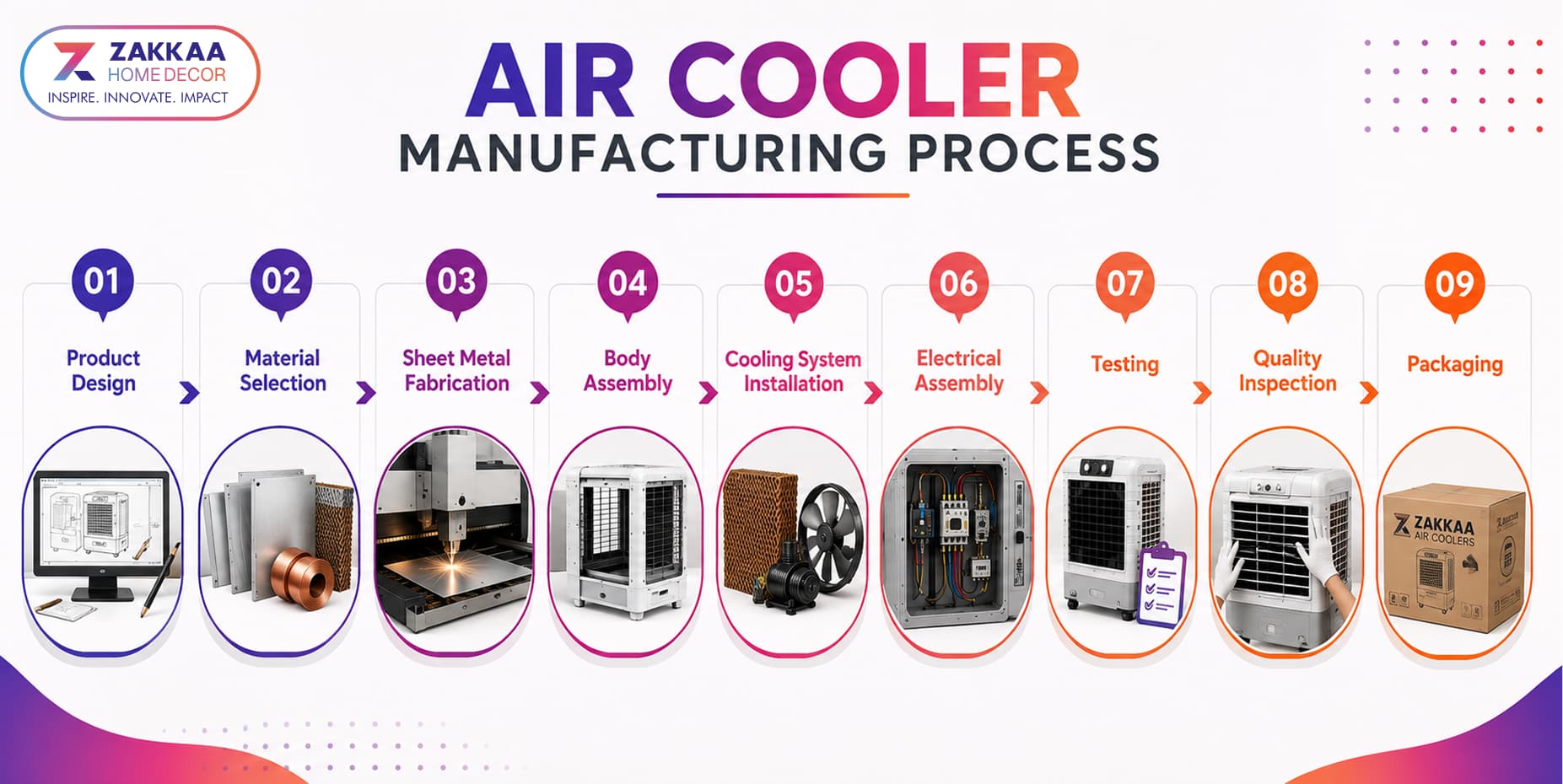
Each stage has a direct impact on the finished product, so quality control should not be treated as something that happens only at the end.
How Are Air Coolers Made: Complete Manufacturing Process
Stage 1. Product Design And Engineering
Manufacturing starts before any sheet is cut.
The manufacturer first defines the product specifications according to the intended application. This may include cooler dimensions, airflow requirements, water tank capacity, cooling-pad arrangement, fan size, motor rating, controls, portability, and appearance.
For OEM products, the brand may provide its own specifications or work with the manufacturer to develop them.
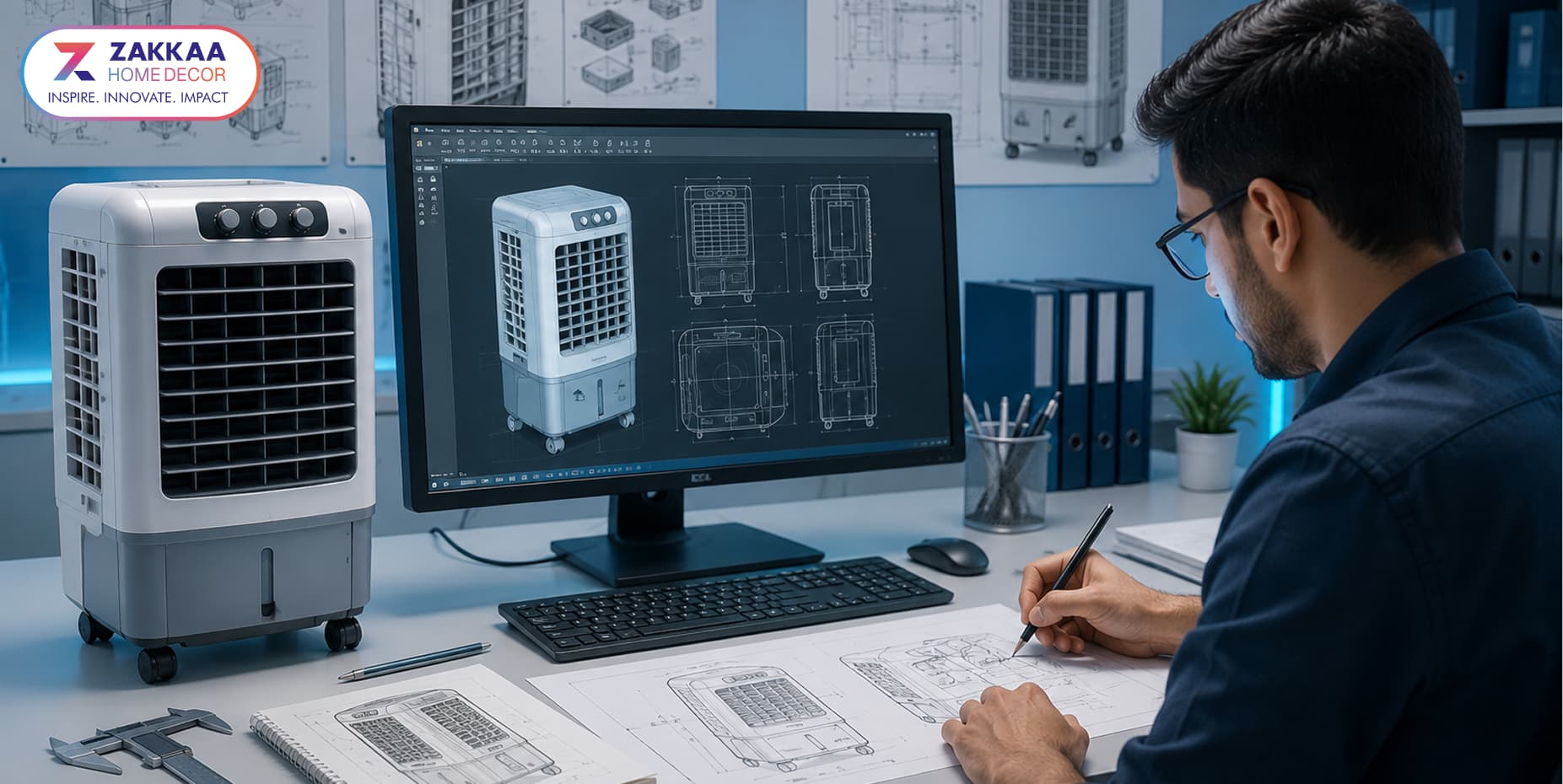
Engineers also need to consider practical issues such as:
Air inlet and outlet placement
Water circulation
Cooling-pad position
Motor and pump placement
Electrical component access
Tank filling
Drainage
Cleaning access
Wheel placement
Product stability
A good design should not only look attractive; it should also make manufacturing, assembly, servicing, and everyday use practical.
Stage 2. Material Selection To Create Air Cooler
The materials used in the cooler body and internal components affect durability and production quality.
Depending on the product design, manufacturers may use sheet metal, engineering plastics, electrical components, motors, pumps, cooling pads, wiring, hardware, and other supporting components.
For sheet-metal coolers, the manufacturer selects an appropriate sheet specification based on the product's structural requirements.
Material selection should consider:
Strength
Weight
Corrosion resistance
Formability
Surface finish
Product cost
Intended usage
For an OEM product, these specifications should be agreed upon before mass production so that the finished units remain consistent with the approved design.
Stage 3. Sheet Metal Cutting And Fabrication
For coolers using metal bodies, sheet metal fabrication is one of the important manufacturing stages.
Large sheets are first cut into the required dimensions. Depending on the design and production setup, manufacturers may use processes such as CNC laser cutting, shearing, punching, bending, and forming.
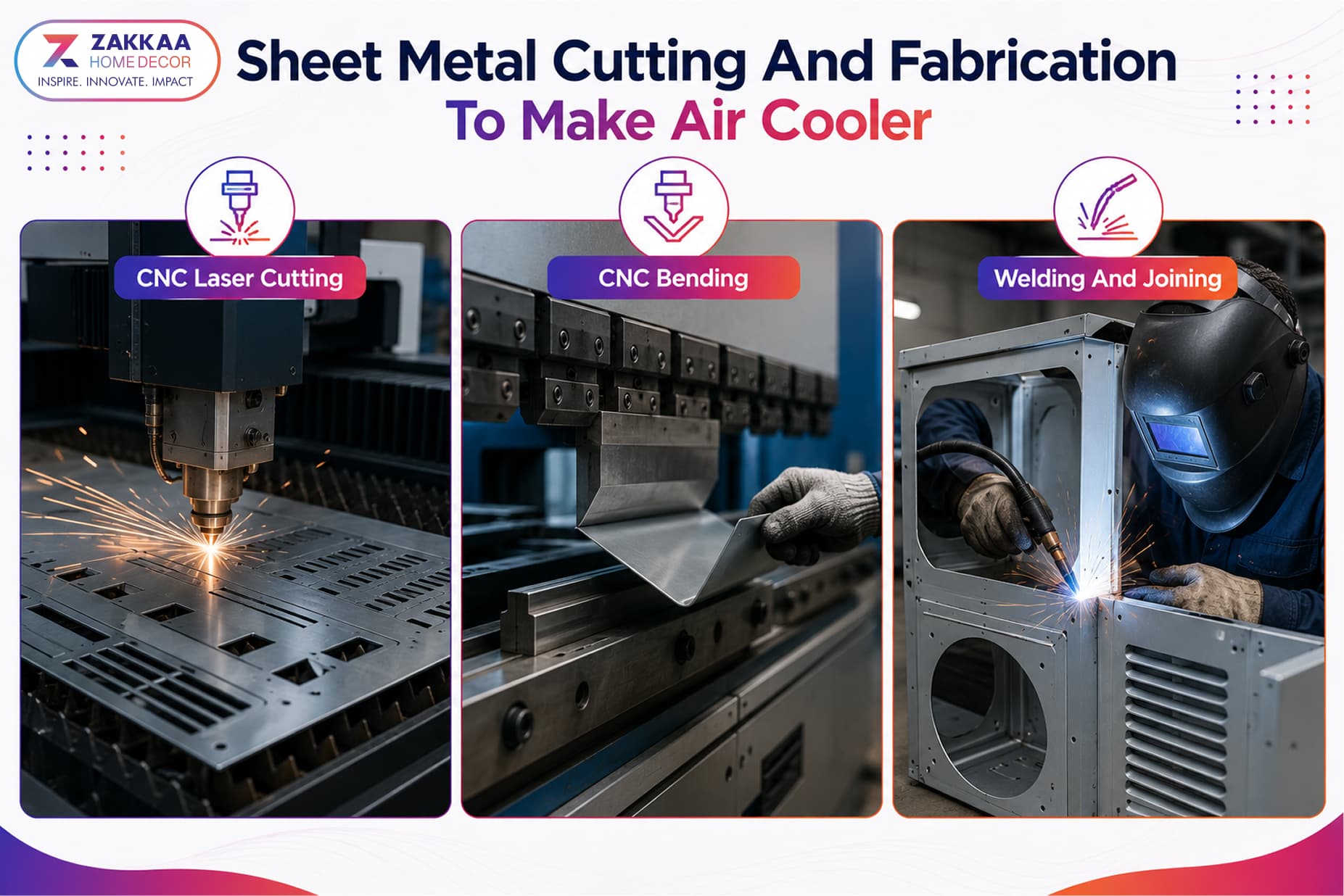
The purpose is to create accurately sized panels and components that can later be assembled into the cooler body.
1. CNC Laser Cutting
CNC laser cutting uses computer-controlled equipment to cut sheet metal according to the required design.
It can be useful for producing:
Ventilation openings
Fan openings
Control-panel cut-outs
Mounting holes
Brackets
Body panels
Accurate cutting helps ensure that different components fit together properly during assembly.
2. CNC Bending
After cutting, flat sheets may need to be bent into specific shapes.
CNC press brakes can create accurate bends for side panels, top sections, brackets, frames, and other components.
Proper bending is important because inconsistent dimensions can create alignment problems during assembly.
3. Welding And Joining
Some metal components need to be joined before the final body assembly.
Depending on the design, manufacturers may use suitable welding or fastening methods to create strong joints while maintaining the required appearance.
The quality of these joints matters because the cooler body must withstand regular handling, movement, vibration, and everyday operation.
Stage 4. Surface Finishing
Once metal components have been fabricated and joined, they may undergo surface preparation and finishing.
For many metal air coolers, powder coating is used to provide a durable and uniform surface finish.
The process generally involves preparing the metal surface before applying the powder coating and curing it under controlled conditions.
A proper finish can improve:
Appearance
Surface durability
Resistance to everyday wear
Corrosion protection
Product consistency
For OEM manufacturing, colour and finish can also be selected according to the brand's product requirements.
Stage 5. Manufacturing The Cooler Body
After fabrication and finishing, the individual panels are assembled to form the main cooler body.
This stage requires proper alignment because the body must accommodate the fan, motor, pump, cooling pads, water tank, control panel, wiring, and other components.
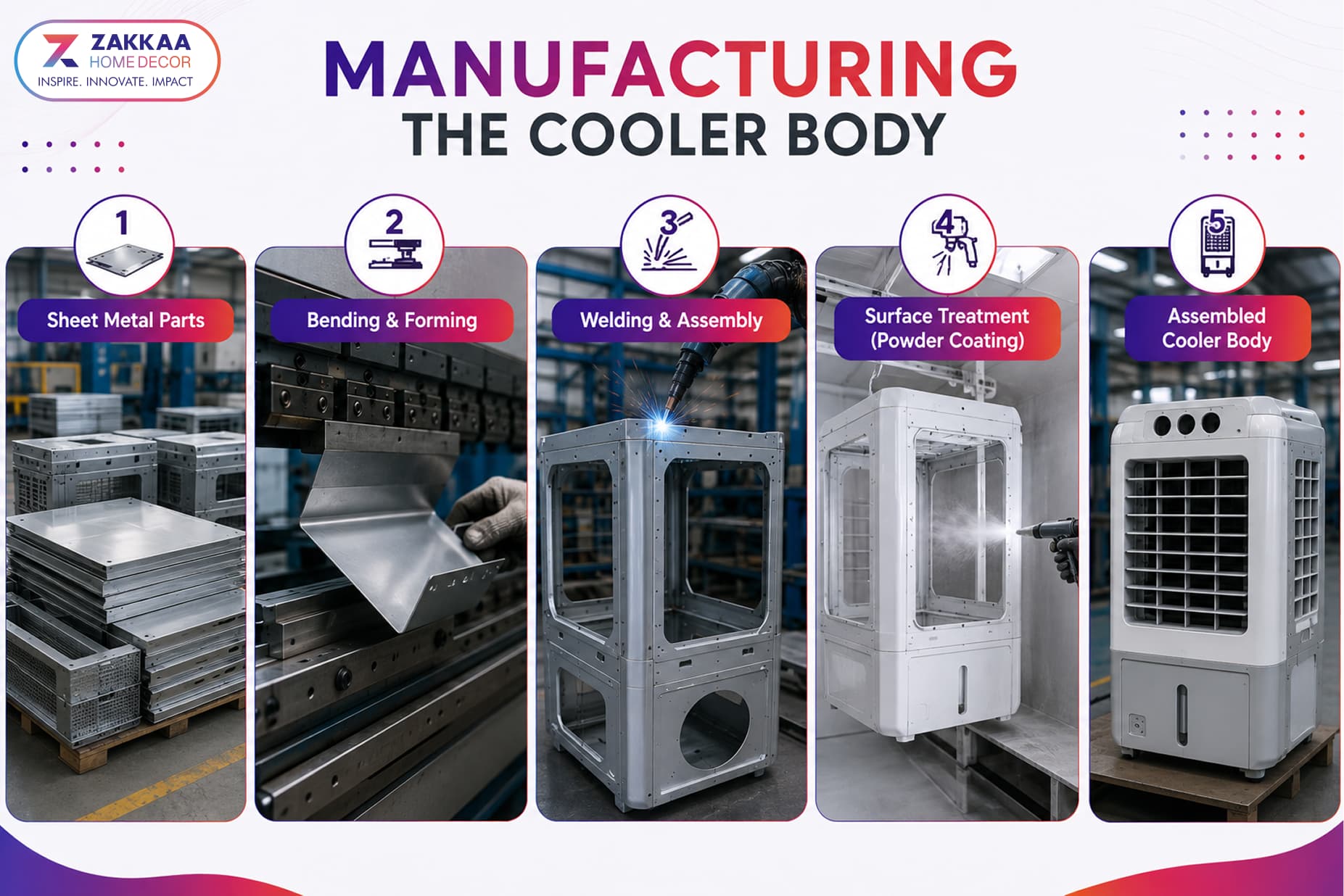
The manufacturer also needs to ensure that:
Panels fit correctly
Doors or access panels operate properly
Water does not leak from the tank
Components remain securely mounted
Air passages are not unnecessarily obstructed
The cooler remains stable during operation
A well-designed body should also provide reasonable access for cleaning and servicing.
Stage 6. Installing Cooling Pads And Water System
Cooling pads are central to evaporative cooling.
Honeycomb cooling pads are commonly used in many air coolers because their structure provides a large surface area for water and air interaction.
During assembly, the pads are positioned so that water can distribute across them properly. A water pump circulates water from the tank toward the distribution system, keeping the pads wet while the fan draws air through them.
The manufacturer needs to check that water reaches the cooling-pad area evenly and that there are no unwanted leaks or blockages.
The tank should also be designed for practical filling, cleaning, and drainage.
Stage 7. Fan And Motor Assembly
The fan and motor determine how effectively air moves through the cooler.
During assembly, the motor and fan are installed and aligned according to the product design. The manufacturer checks that the fan rotates properly without unwanted rubbing or excessive vibration.
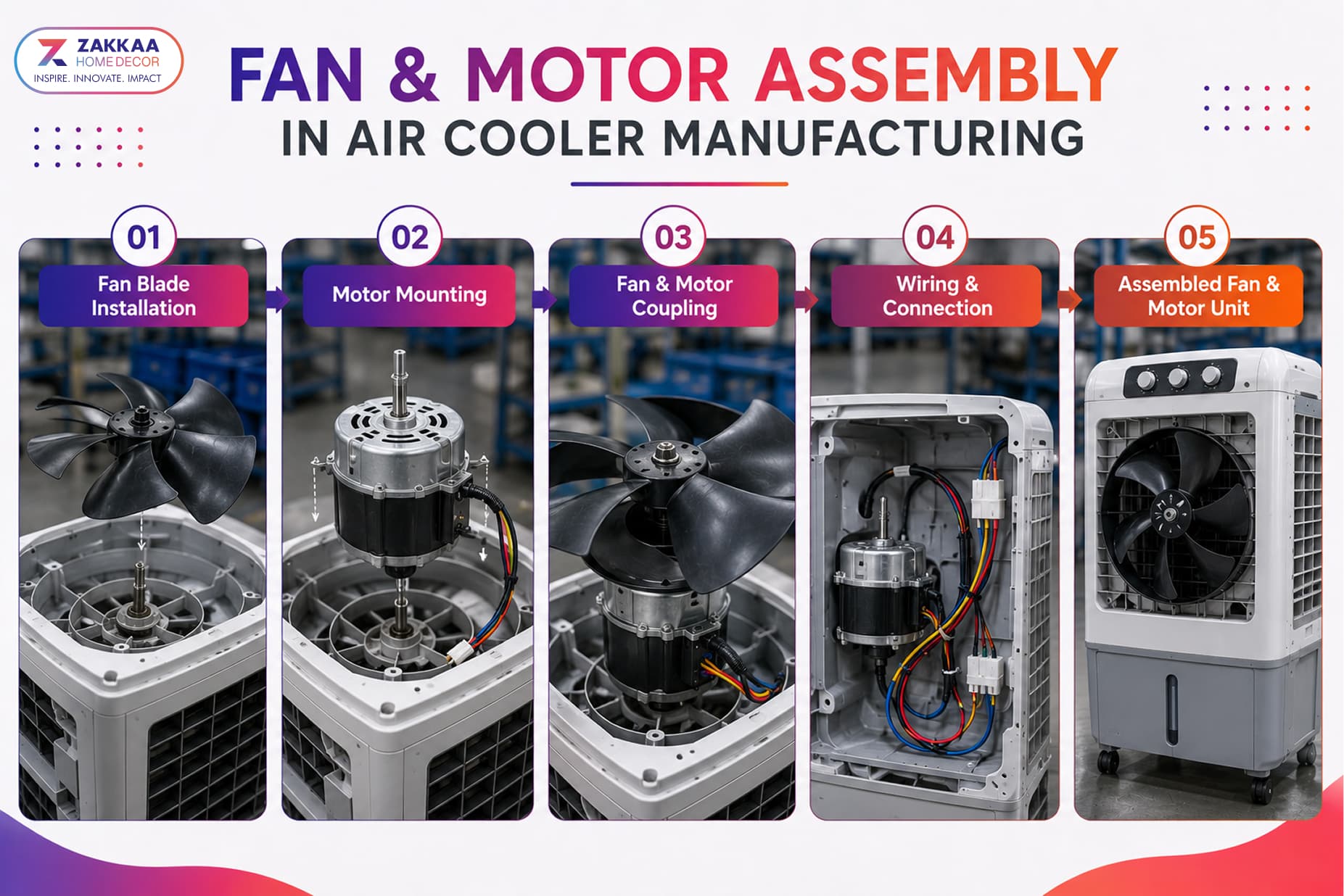
Depending on the model, the assembly may include a fan or blower, motor, motor mounting, fan housing, speed controls, oscillation mechanism, and air-direction components.
A quality check at this stage can identify vibration, unusual noise, incorrect rotation, or alignment problems before the product reaches final testing.
Stage 8. Electrical Assembly
The electrical system connects the motor, pump, controls, switches, wiring, and other electrical components.
This stage requires careful assembly because electrical safety is an essential part of a household appliance.
Manufacturers check areas such as:
Wiring connections
Insulation
Switch operation
Motor operation
Pump operation
Earthing
Control-panel functionality
Electrical safety
Components should be assembled according to the product's electrical design and applicable safety requirements.
Stage 9. Water Leakage And Functional Testing
Before final quality inspection, the cooler should be tested under operating conditions.
The water system is checked for leakage, while the pump is operated to verify proper water circulation.
Manufacturers may check:
Water Tank → Pump → Distribution System → Cooling Pads → Drainage
The objective is to ensure that water moves through the intended path without leakage or abnormal operation.
This stage is particularly important because even a small leakage problem can affect electrical components or create inconvenience for the user.
Stage 10. Airflow And Cooling Performance Testing
A cooler may look perfectly assembled but still fail to deliver the expected performance.
That's why manufacturers should test the unit's functional performance against the product specifications.
Based on the product, testing may include airflow, fan speed, air throw, water circulation, cooling-pad wetting, power consumption, noise and vibration, and control operation.
Testing helps identify whether the finished cooler performs as intended rather than relying only on visual inspection.
Stage 11. Final Quality Inspection
The final inspection brings together checks from the entire manufacturing process.
Air cooler quality assurers can examine the cooler's body alignment, surface finish, panel fit, wheels, fan operation, water tank, cooling pads, pump, electrical system, controls, drainage, and packaging condition.
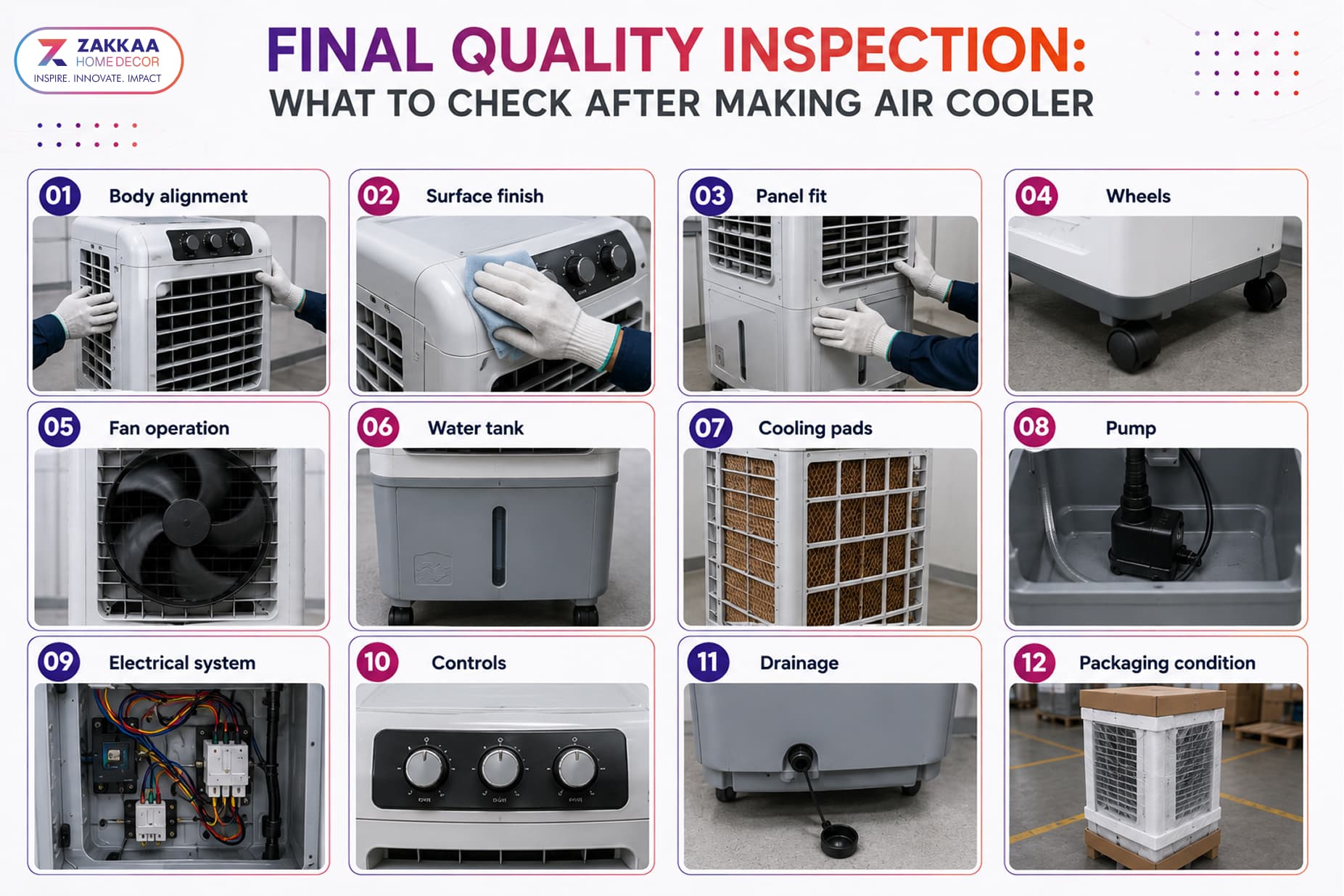
The exact inspection checklist depends on the product specification and the manufacturer's quality system.
For OEM manufacturing, maintaining a defined quality standard is particularly important because customers expect every production batch to match the approved product.
How Does A Manufacturer Ensure Consistent Air Cooler Quality?
Consistency becomes increasingly important when producing hundreds or thousands of units.
A professional manufacturing setup can use standardised drawings, approved component specifications, process checks, inspection points, and batch-level testing to reduce variations between products.
For example, if a brand approves a particular body design, cooling-pad configuration, motor specification, and colour, these requirements should be documented before mass production.
This helps the manufacturer maintain the same product specifications across production batches.
What Affects Air Cooler Manufacturing Cost?
The cost of manufacturing an air cooler does not depend on one component alone.
It can be influenced by cooler size, sheet material, body construction, motor specification, fan design, pump, cooling-pad type and size, water tank capacity, electrical components, control panel, surface finish, tooling requirements, product testing, packaging, production quantity, and customisation.
A higher production volume can change the per-unit economics, while extensive customisation may require additional tooling, development, or production work.
For OEM buyers, it is therefore better to discuss the complete product specification and expected order quantity before comparing manufacturing quotations.
Why Choose An OEM Air Cooler Manufacturer?
For a brand entering the cooling-appliance market, manufacturing is not simply about finding someone who can assemble an air cooler.
An OEM manufacturing partner should have the capability to handle the required manufacturing stages, maintain product specifications, manage component sourcing, conduct quality checks, and scale production according to demand.
An experienced cooler manufacturer can also help brands develop products for different market segments, from compact personal coolers to larger cooling solutions.
Why Choose Zakkaa For Air Cooler Manufacturing?
Zakkaa is an Indian OEM manufacturer of air cooling products, supporting brands and businesses with product manufacturing requirements for the Indian market.
Our manufacturing capabilities cover key stages such as sheet metal fabrication, component assembly, surface finishing, electrical integration, testing, and quality inspection. This allows businesses to develop air coolers around defined specifications rather than relying only on standard products.
Zakkaa can support OEM requirements involving product design specifications, configurations, finishes, production quantities, and other business requirements, depending on the project.
For brands planning to enter the air-cooling market or expand their existing product range, working with an OEM manufacturer in India can provide greater control over product specifications, manufacturing, customisation, and production scalability.
Final Remarks
Quality air cooler manufacturing starts long before the finished product is switched on. Product engineering, suitable materials, accurate sheet metal fabrication, reliable components, proper assembly, cooling-system installation, electrical checks, and performance testing all contribute to the final product.
For brands, the choice of manufacturer can therefore have a direct impact on product quality and production reliability. You can partner with an experienced Indian OEM cooler manufacturer to turn defined air cooler specifications into commercially ready products while supporting manufacturing, customisation, and bulk production requirements.
Frequently Asked Questions (FAQs)
What Is The Main Process Used In Air Cooler Manufacturing?
Air cooler manufacturing typically involves design, material selection, fabrication, component assembly, electrical integration, testing, quality inspection, and final packaging before dispatch.
Which Material Is Commonly Used For Air Cooler Bodies?
Air cooler bodies can be manufactured using sheet metal or engineered plastics, depending on the design. Material selection depends on durability, weight, appearance, cost, and intended application.
What Are Honeycomb Cooling Pads Used For?
Honeycomb cooling pads provide a large surface area for water and air interaction. This supports evaporative cooling by allowing incoming air to pass through the wet pad structure.
Why Is CNC Cutting Used In Air Cooler Manufacturing?
CNC cutting helps produce accurately sized metal panels, openings, brackets, and other components according to digital designs. This improves dimensional accuracy and supports better assembly.
How Is An Air Cooler Tested Before Dispatch?
Manufacturers can check airflow, fan operation, water circulation, leakage, power consumption, controls, noise, vibration, and overall construction before approving units for packaging and dispatch.
What Should Brands Look For In An Air Cooler Manufacturer?
Look for manufacturing capabilities, quality-control processes, component sourcing, testing facilities, production capacity, customisation support, and experience handling the required product specifications.
Can Air Coolers Be Customised For OEM Requirements?
Yes, OEM air coolers can be developed around requirements such as dimensions, airflow, tank capacity, cooling pads, controls, colours, finishes, packaging, and other product specifications.
How Does Production Quantity Affect Air Cooler Manufacturing?
Production quantity can influence tooling, component procurement, manufacturing planning, and per-unit costs. Discussing expected volumes early helps manufacturers prepare a more suitable production proposal.